
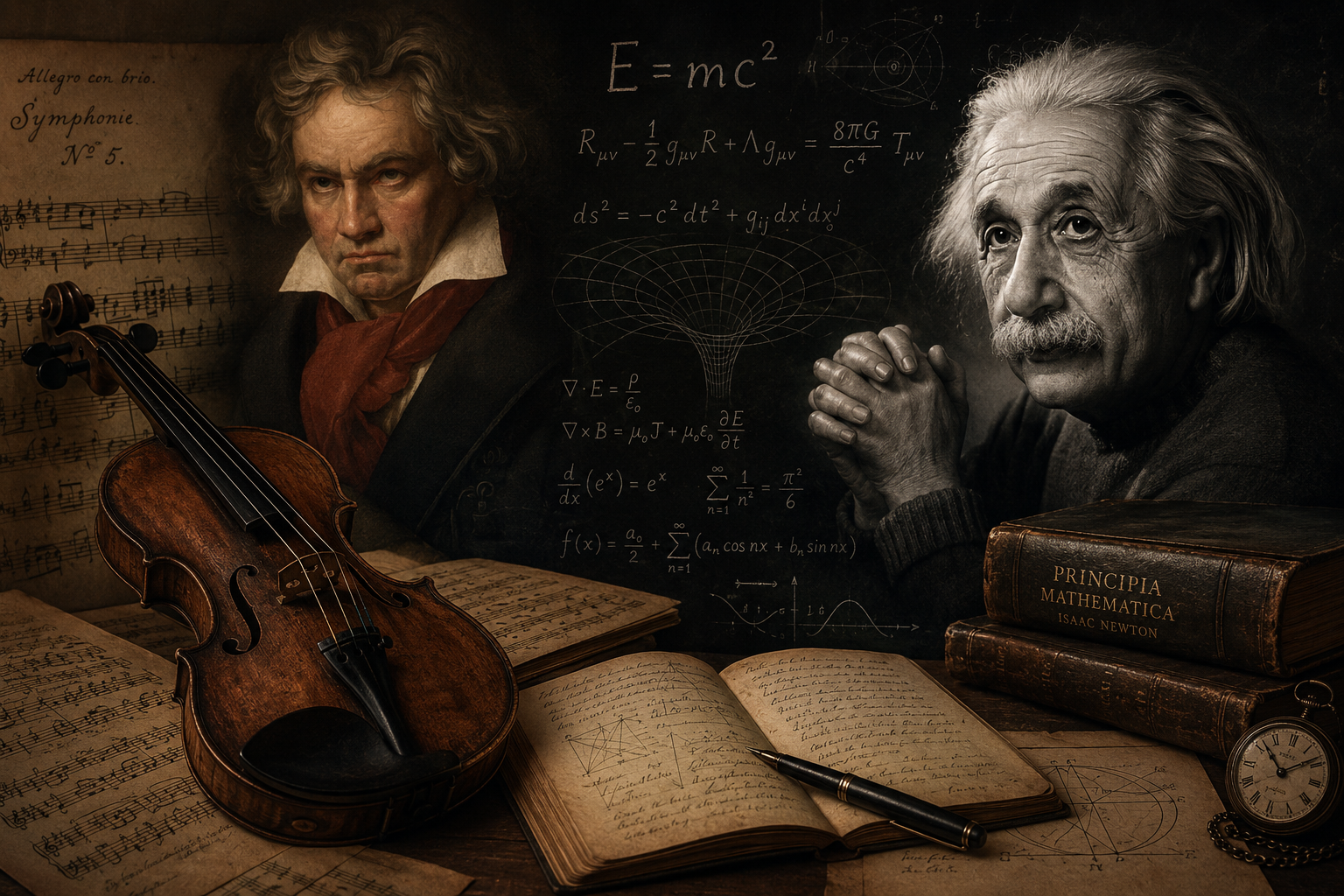
Beethoven, Einstein and the Mathematics of Harmony
What if music, mathematics, and physics are not separate worlds?
What if a symphony and an equation are simply two different ways of discovering hidden order inside reality?
At first glance, music and mathematics seem to belong to opposite universes.
One speaks to emotion.
The other to logic.
One moves the heart.
The other structures thought.
Yet some of the greatest minds in history sensed that beneath both lies the same mysterious architecture.
Perhaps no trio represents this idea more beautifully than Beethoven, Einstein, and mathematics.
Einstein Did Not See Physics as Mere Calculation
To many people, Albert Einstein is associated with formulas, blackboards, and impossible calculations.
But Einstein himself often described science in almost artistic terms.
He played the violin nearly every day. Music was not a hobby for him. It was a way of thinking.
For Einstein, the universe was not simply a machine.
It was a form of hidden harmony.
He believed that the deepest physical laws should possess elegance, simplicity, and internal beauty.
In his view, truly profound theories were not merely correct.
They were beautiful.
The Musical Intuition Behind Scientific Thought
Einstein often spoke about intuition as an essential component of scientific discovery.
Not intuition in the mystical sense, but a kind of deep internal feeling for structure and coherence.
Music appears to have played an important role in that process.
Biographers and historians frequently describe how Einstein turned to the violin during periods of intense scientific work. Music helped him think.
Not linearly.
Not mechanically.
But structurally.
Like many physicists of his era, Einstein searched for unity beneath complexity — a hidden order connecting seemingly unrelated phenomena.
That search resembles musical composition more than calculation.
A great symphony does not feel random.
Every movement, tension, silence, and return exists within an invisible architecture.
Einstein sought the same thing in nature.
Beethoven and the Architecture of Emotion
Ludwig van Beethoven is often remembered as the composer of overwhelming emotion: dramatic crescendos, storms of sound, explosive intensity.
But beneath that emotional power lies astonishing structural discipline.
His symphonies are built through patterns, transformations, repetitions, and proportional balance.
Small motifs evolve gradually across entire movements.
Musical ideas return transformed.
Themes fracture, expand, disappear, and re-emerge with new meaning.
Beethoven could take a tiny musical fragment and unfold an entire universe from it.
Consider the famous opening of the Fifth Symphony:
ta-ta-ta-TAAA
Four notes.
That is all.
Yet from this microscopic idea, Beethoven constructs one of the most recognizable and emotionally powerful musical journeys ever written.
The motif mutates continuously throughout the symphony.
It behaves almost like a mathematical object passing through different forms while preserving its hidden identity.
The Ancient Connection Between Music and Mathematics
The relationship between music and mathematics stretches back more than two thousand years.
The Pythagorean tradition explored the connection between harmonious sounds and numerical ratios through experiments involving vibrating strings and monochords.
Certain musical intervals appeared to correspond to simple mathematical relationships.
For example:
- the octave corresponds to a ratio of
2:1 - the perfect fifth corresponds to
3:2
This discovery profoundly influenced the history of science and philosophy.
It suggested that harmony itself might possess mathematical structure.
And if music could be governed by numerical relationships, perhaps the universe itself contained hidden mathematical order.
That idea would echo through centuries of intellectual history.
Mathematics as the Language of Hidden Structure
Centuries later, Einstein pursued a similar dream through physics.
His equations attempted to reveal the invisible geometry beneath reality: space, time, gravity, motion.
Not chaos — but structure waiting to be understood.
For Einstein, mathematics was not merely a computational tool.
It was the language capable of expressing the deep architecture of existence.
The elegance of a theory mattered.
Simplicity mattered.
Symmetry mattered.
In this sense, physics and music begin to resemble each other.
Both search for coherence beneath complexity.
Both seek forms that feel inevitable.
Both transform invisible relationships into human experience.
Mathematics is music that thinks.
Music is mathematics that feels.
Perhaps this is why so many scientists love music deeply.
And why so many composers speak about balance, tension, symmetry, release, and form almost like mathematicians.
They are approaching the same mystery from different directions.
The Search for Hidden Order
Beethoven searched for emotional truth through musical structure.
Einstein searched for cosmic truth through mathematical structure.
Both believed that beneath complexity there exists a deeper simplicity.
A hidden coherence.
A form of harmony.
And perhaps this is the real connection between music, mathematics, and science:
the intuition that reality is not random noise — but patterned meaning.
We usually think of equations as cold and symphonies as emotional.
But maybe the greatest discoveries happen precisely when logic and beauty stop being opposites.
Maybe the universe itself is closer to a composition than to a machine.
And maybe the mathematician, the physicist, and the composer are all listening for the same hidden music.
Published by EisatoponAI
EisatoponAI is an independent intellectual publication exploring mathematics, science, paradoxes, AI, philosophy, and the hidden structures behind reality.
Calm, elegant, and deeply curious — designed for readers who want more than information.