
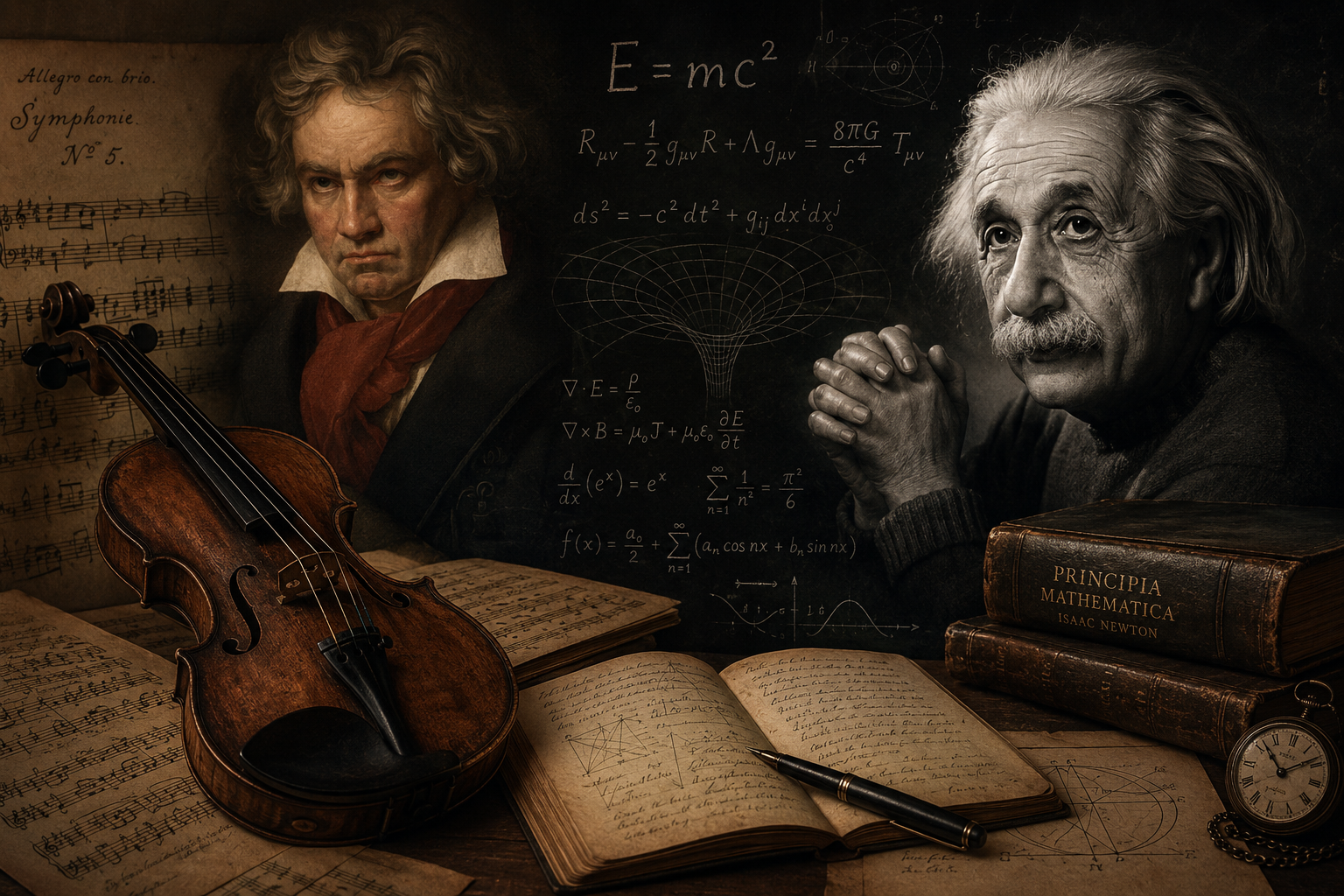
Beethoven, Einstein and the Mathematics of Harmony
What if music, mathematics, and physics are not separate worlds?
What if a symphony and an equation are simply two different ways of discovering the same hidden order inside reality?
At first glance, music and mathematics seem to belong to opposite universes.
One speaks to emotion.
The other to logic.
One moves the heart.
The other structures thought.
Yet some of the greatest minds in history sensed that beneath both lies the same mysterious architecture — not as a poetic metaphor, but as a structural fact.
This article is an attempt to show why.
Einstein's Other Instrument
Most people picture Albert Einstein at a blackboard, surrounded by tensors and field equations.
The image is accurate but incomplete.
Einstein played the violin from the age of six. He performed Mozart and Bach throughout his adult life. When he was struggling with a difficult problem, he would often stop, pick up the violin, and play — sometimes for hours. His son Hans Albert later recalled that music seemed to unlock something in his father's thinking: "Whenever he felt that he had come to the end of the road or into a difficult situation in his work, he would take refuge in music, and that would usually resolve all his difficulties."
Einstein himself was explicit about the connection. "If I were not a physicist, I would probably be a musician," he said. "I often think in music. I live my daydreams in music. I see my life in terms of music."
This was not a hobby talking. It was a description of cognitive process.
For Einstein, music and physics shared a structural principle: both involved the search for invariance — patterns that remain true regardless of how you look at them. A musical theme that returns transformed is still recognizably itself. A physical law that holds in any reference frame is still the same law. In both cases, the deepest truths are the ones that survive transformation.
Beethoven's Hidden Architecture
Ludwig van Beethoven is often remembered through his emotional extremity: the deafness, the fury, the explosive crescendos.
But beneath the emotion lies something that looks, on close inspection, almost mathematical.
Consider the opening of the Fifth Symphony. Four notes:
G — G — G — E♭
Short — short — short — long. Three identical pitches and one that falls.
This is one of the most analyzed motifs in the history of music, and for good reason: Beethoven does not use it as an introduction and then move on. He transforms it continuously across all four movements — stretching it, inverting it, fragmenting it, combining it with itself in different voices, slowing it to a funeral pace, accelerating it into triumph.
The motif behaves like a mathematical object under a group of transformations. It changes form while preserving identity. The symphony is, in a precise sense, an extended exploration of what this four-note structure can become while remaining itself.
This is not coincidence or instinct. Beethoven's sketchbooks reveal a composer who worked through ideas with something close to systematic rigor — drafting, discarding, revising, testing combinations. The emotional power of his music is real, but it is built on structural discipline that a mathematician would recognize.
The Pythagoreans Were Right About Something
The connection between music and mathematics is ancient — and it began with a physical discovery, not a philosophical one.
Around the sixth century BCE, the Pythagorean school conducted experiments with vibrating strings. They discovered something that must have felt extraordinary at the time: the intervals that the human ear perceives as harmonious correspond to simple integer ratios in string length.
- Octave: a string half the length of another vibrates at exactly twice the frequency. Ratio
2:1. - Perfect fifth: ratio
3:2. - Perfect fourth: ratio
4:3. - Major third: ratio
5:4.
The simpler the ratio, the more consonant the interval sounds to human ears. This is not culturally constructed — it is grounded in the physics of resonance. When two frequencies share a simple ratio, their wave patterns overlap periodically and reinforce each other. The ear perceives the result as stable, resolved, harmonious.
When the ratio is complex — say 45:32 for the tritone — the wave patterns fall in and out of alignment irregularly. The ear perceives tension, instability, the feeling that something needs to resolve.
This is the deep fact that the Pythagoreans had found: harmony is not a feeling we project onto sound. It is a physical relationship that our perceptual system has learned to detect.
The implication was immediate and radical. If music — something humans experience as purely emotional — is secretly governed by mathematical structure, what else might be? The Pythagorean conviction that number underlies all things was not mysticism. It was a hypothesis generated by empirical observation.
It would take two thousand years to find out how right they were.
Einstein's Equations and the Search for Invariance
When Einstein published the special theory of relativity in 1905, the central achievement was not a new fact about the universe. It was a new principle: the laws of physics must take the same form in every inertial reference frame.
This is a statement about symmetry. It says that the universe does not have a privileged perspective — no observer is more correct than any other. The equations that describe reality must be invariant under the transformations that connect different observers.
From this single symmetry requirement, an enormous amount follows: the equivalence of mass and energy, the relativity of simultaneity, time dilation, length contraction. The famous equation E = mc² is not an isolated fact. It is a consequence of insisting on a particular kind of mathematical symmetry.
Einstein's later work on general relativity pushed this further. Gravity itself turned out to be a consequence of requiring the laws of physics to be invariant not just under uniform motion but under arbitrary changes of coordinates — a much larger symmetry group. The geometry of spacetime curves because that curvature is what makes the physics look the same to every observer, regardless of how they are moving.
Beauty, for Einstein, meant this: a theory that achieves enormous explanatory power from a small number of symmetry requirements. "The most beautiful thing we can experience is the mysterious," he wrote. "It is the source of all true art and science."
The word beautiful here is precise, not decorative. Einstein meant theories that feel inevitable — where, once you understand the symmetry, you cannot imagine the universe being any other way.
The Shared Structure
Here is where Beethoven and Einstein converge — not as a metaphor but as a structural observation.
Both are working with transformations that preserve identity.
Beethoven takes a four-note motif and subjects it to operations: transposition (the same pattern starting on a different pitch), inversion (the intervals flipped upside down), augmentation (the rhythm stretched), diminution (the rhythm compressed), fragmentation (just the first two notes), stretto (the motif overlapping with itself in different voices). Through all of these operations, the motif remains recognizably itself. The symphony is an investigation of its invariants.
Einstein takes a physical law and asks: under what transformations does it remain the same? What symmetries does nature actually possess? The theory of relativity is an investigation of the invariants of spacetime — the quantities and relationships that remain true regardless of the observer's motion.
The mathematical language for both is the same: group theory, the branch of mathematics that studies transformations and the structures they preserve. The set of musical operations Beethoven applies to his motif forms a group in the mathematical sense. The set of coordinate transformations Einstein uses in relativity forms a group — the Lorentz group.
Neither Beethoven nor Einstein would have described their work in these terms. But the structure is there.
Why the Human Ear Responds
There is one more layer worth examining.
The Pythagorean discovery — that consonance corresponds to simple frequency ratios — has a neurological dimension that the ancient Greeks could not have known about.
When two frequencies share a simple ratio, they produce a regular pattern of coincident overtones in the harmonic series. The auditory system, which evolved to detect and analyze periodic sound patterns, perceives this regularity as stability. The simpler the ratio, the more regular the overlap, the more the brain interprets the sound as resolved.
Dissonance is literally the perception of acoustic irregularity — a pattern that has not yet found its stable form.
This means that musical tension and resolution are not arbitrary cultural conventions. They are responses to physical relationships in sound waves, mediated by a perceptual system that has learned to find meaning in mathematical regularity.
When Beethoven builds tension by piling up dissonances and releases it through resolution to a perfect fifth or octave, he is — knowingly or not — manipulating a perceptual response to mathematical structure.
The emotion is real. The mathematics underneath it is also real.
They are not two different things. One is the human experience of the other.
The Deeper Claim
The argument of this article is not that music and physics are secretly the same thing.
They are not. Music is a human art form, shaped by culture, performance, and feeling. Physics is an empirical discipline constrained by experimental evidence. They use different methods and serve different purposes.
The claim is more specific: both music and physics, at their most fundamental level, are investigations of invariance under transformation. They ask what remains true when everything that can change has changed. They search for structure that is deeper than any particular instance of it.
The Pythagoreans found this first, in the ratios of vibrating strings.
Beethoven enacted it, in four notes subjected to two hundred years of analysis.
Einstein formalized it, in the symmetry requirements of spacetime.
And the human brain — shaped by evolution to find pattern, to detect regularity, to feel the difference between resolution and tension — responds to all three with the same basic recognition:
something here is organized.
Perhaps the universe does not merely permit mathematics and music to exist within it. Perhaps the structures we call harmony, symmetry, and elegance are different names for the same thing — the tendency of deep order to make itself perceptible, whether through the ear, the eye, or the equation.
EisatoponAI
An independent intellectual publication exploring mathematics, AI, science, paradoxes, and the hidden structures behind reality.