
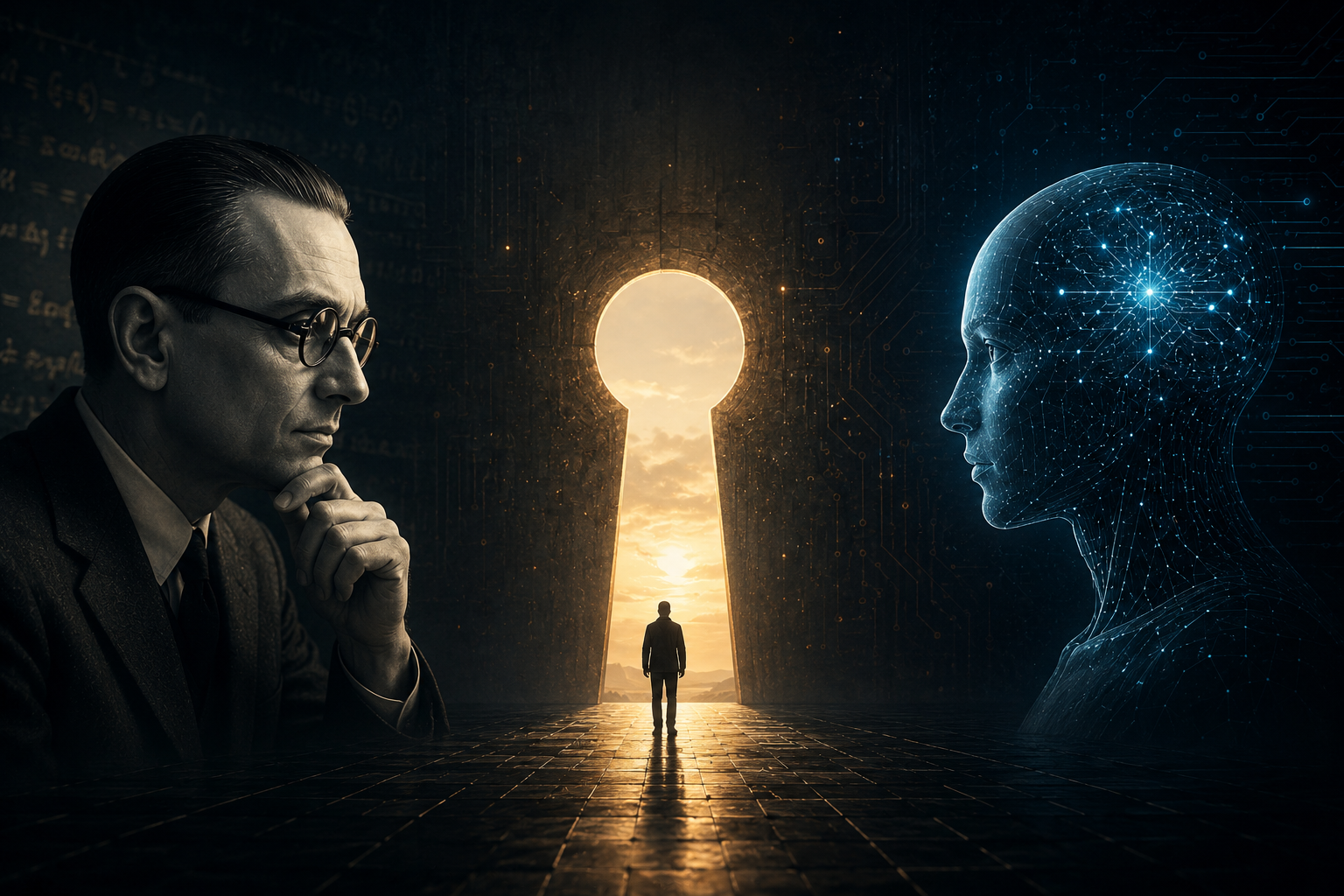
Gödel's Incompleteness Theorem and the Limits of AI
In 1931, a twenty-five-year-old Austrian logician named Kurt Gödel published a result that permanently changed mathematics, logic, philosophy, and eventually computer science.
The paper was called "On Formally Undecidable Propositions of Principia Mathematica and Related Systems."
The title was technical. The consequences were not.
Nearly a century later, Gödel's theorem sits at the center of one of the most important questions humanity has ever faced: are there things a machine can never understand? And if so — what does that tell us about the nature of intelligence itself?
The Dream That Gödel Destroyed
To understand what Gödel proved, you first have to understand what mathematicians believed before him.
At the turn of the twentieth century, the dominant hope was that mathematics could be placed on perfectly secure foundations. The great mathematician David Hilbert articulated the vision precisely: build a formal system — a set of axioms and rules of inference — powerful enough to derive all of mathematics, consistent enough to contain no contradictions, and complete enough that every true mathematical statement could eventually be proven within it.
This was called Hilbert's Program. It was one of the most ambitious intellectual projects in history.
Then Gödel arrived. And in a single paper, he proved that Hilbert's dream was impossible — not merely difficult, not merely incomplete, but mathematically impossible in principle.
The Proof: A Statement That Talks About Itself
The technical machinery of Gödel's proof is intricate, but the central idea is one of the strangest and most beautiful in all of mathematics.
Gödel's key innovation was showing that any formal system powerful enough to describe arithmetic can be made to talk about itself. He constructed a method — now called Gödel numbering — for encoding statements about the system as numbers within the system. Every formula, every proof, every sequence of logical steps could be translated into a unique integer. The system could therefore make statements about its own statements.
With this tool in hand, Gödel constructed a specific statement — call it G — that effectively says:
"This statement cannot be proven within this system."
Now consider what follows. If G is false, then it can be proven — but that would mean the system proves something false, making it inconsistent. If G is true, then it cannot be proven — meaning the system is incomplete: it contains a true statement it can never derive.
Either the system is inconsistent, or it is incomplete. There is no third option.
For any consistent formal system powerful enough to do arithmetic, G is true — and permanently unprovable within the system. You can extend the system by adding G as a new axiom, but Gödel's construction can be applied again to generate a new unprovable statement. The process never terminates. Incompleteness is not a bug to be patched. It is a structural property of sufficiently powerful formal systems.
This is the First Incompleteness Theorem.
The Second goes further: any sufficiently powerful consistent system cannot prove its own consistency. It cannot, using only its own internal rules, guarantee that it will never produce a contradiction. The system cannot fully see itself from the inside.
What Makes This So Disorienting
Mathematicians before Gödel assumed that truth and provability were the same thing — that if something was true, a proof must exist somewhere, waiting to be found.
Gödel separated them permanently.
There are mathematical truths that exist beyond the reach of proof within any given system. Not because we haven't found the proof yet. Because no proof can exist there. The universe of mathematical truth is strictly larger than the universe of what any formal system can derive.
This is not a statement about human limitations. It is a statement about the structure of formal reasoning itself.
The Question for AI
Modern AI systems — from symbolic theorem provers to neural networks to large language models — are, at their core, computational processes. They operate according to formal rules, whether those rules are explicit logical axioms or learned statistical weights derived from training data.
This raises an immediate question: do Gödel's limits apply to AI?
The answer requires care, because the question contains a hidden ambiguity. Gödel's theorems apply specifically to formal systems — systems that manipulate symbols according to fixed rules and make claims about mathematical truth. Whether modern AI systems fall cleanly into that category depends on what, exactly, you think they are doing.
For symbolic AI — systems that explicitly reason through logical rules, like early expert systems or automated theorem provers — the connection is direct. These systems are formal systems in Gödel's sense, and they inherit his limits.
For statistical systems like large language models, the situation is murkier. These systems do not prove theorems. They predict token sequences based on learned probability distributions. Whether Gödel's incompleteness results apply to statistical inference engines in any meaningful sense is genuinely unclear — and anyone who tells you otherwise with confidence is overstating the current state of the field.
The Lucas–Penrose Argument
The most famous attempt to apply Gödel directly to the question of machine consciousness came from philosopher J. R. Lucas in 1961, later expanded dramatically by physicist Roger Penrose.
The argument runs roughly as follows. Humans, when presented with a Gödel statement for a given formal system, can recognize that it is true — even though the system itself cannot prove it. We step outside the system and see its truth from a vantage point the system cannot occupy. Formal machines cannot do this. Therefore, human mathematical understanding transcends formal computation. Therefore, minds are not machines.
It is a striking argument. It is also widely considered to be flawed, for reasons that are worth understanding rather than dismissing.
The first problem is that the argument assumes humans are perfectly consistent reasoners. Gödel's theorem applies to consistent formal systems. Human beings make logical errors, hold contradictory beliefs, and reason incorrectly all the time. If we are inconsistent, Gödel's theorems do not apply to us in the way Lucas and Penrose assume — but then we have no special claim to transcend their limits either.
The second problem is more subtle. When a human "recognizes" the truth of a Gödel statement, what exactly is happening? The recognition requires trusting that the underlying system is consistent — but that trust is itself not something we can prove from within the system. We are making an assumption, not performing a deduction. The human insight Lucas and Penrose celebrate may be less an escape from formal limits than an informal judgment that cannot itself be fully justified.
Penrose went further, proposing that consciousness arises from non-computable quantum processes in the brain — the Orchestrated Objective Reduction theory, developed with anesthesiologist Stuart Hameroff. The idea is that microtubules in neurons perform quantum computations that fall outside the scope of classical Turing machines, and that consciousness is somehow linked to this non-classical processing. The theory remains deeply controversial. Most neuroscientists and physicists are skeptical, and the empirical evidence for quantum effects playing a functional role in cognition is thin. It is worth knowing that the theory exists, but it should not be treated as established science.
The Turing Connection
Gödel's incompleteness results are deeply related to another monumental result from the same era: Alan Turing's proof of the Halting Problem in 1936.
Turing proved that no general algorithm can determine, for every possible program and input, whether the program will eventually halt or run forever. The proof uses a self-referential construction closely analogous to Gödel's: he showed that assuming such an algorithm exists leads to a contradiction, in the same way Gödel's construction leads to contradiction if you assume the system is both complete and consistent.
The connection is not coincidental. Both results are instances of a deeper phenomenon: self-reference within sufficiently powerful systems generates undecidability. Any system expressive enough to talk about itself in full generality will encounter statements or problems that it cannot resolve internally.
For AI, the Halting Problem has concrete implications. There exist computational questions that no algorithm can answer universally. No AI system can solve every possible problem. These are not engineering limitations to be overcome with more compute or better training — they are structural properties of computation itself.
What This Does and Does Not Imply
It is tempting — and common — to read Gödel as delivering a definitive verdict on AI: machines have fundamental limits, humans transcend them, therefore genuine machine intelligence is impossible.
This reading is too fast, in both directions.
Gödel does not protect human intelligence from limits. If the human mind is a physical system, it presumably has its own incompleteness — its own truths it cannot access, its own blind spots built into its architecture. The difference between human and machine cognition, if there is one, is not that humans escape Gödel while machines do not. Both may be subject to analogous limitations. The question is whether the limitations are the same kind, of the same depth, in the same places.
Equally, Gödel does not prevent AI from being extraordinarily capable. Incompleteness says there are truths a system cannot prove — it says nothing about the vast majority of problems that lie well within the system's reach. AI systems already outperform humans across a wide range of tasks, from protein structure prediction to strategic game playing to pattern recognition at scale. Gödel's theorem does not touch any of this.
What Gödel genuinely implies is more modest and more interesting: no sufficiently powerful reasoning system, human or machine, is fully closed. Every such system contains truths it cannot access from within. Every such system's consistency cannot be guaranteed by the system itself. This is a permanent structural feature of formal reasoning, not a temporary technical problem.
The Question That Remains
Perhaps the most honest thing to say about Gödel and AI is that the theorem raises a question it cannot itself answer.
The question is whether genuine understanding — the kind that allows a mathematician to recognize the truth of a Gödel statement, or a reader to follow an argument, or a person to grasp what a sentence means — is the kind of thing that can be captured by any formal system at all. Gödel's theorem shows that formal systems have limits. It does not show what lies beyond those limits, or whether anything that matters cognitively lives there.
Some philosophers believe that meaning, consciousness, and genuine understanding are exactly the things that escape formal capture — that the felt sense of grasping a truth is categorically different from the mechanical derivation of it. Others believe this intuition is an illusion: that what we call understanding is itself a computational process, subject to the same limits as everything else, and that the felt sense of insight is not evidence of transcendence but simply what certain kinds of computation feel like from the inside.
Gödel's theorem does not resolve this debate. It sharpens it.
Ethics and the Incompleteness of Moral Systems
There is one implication of Gödel's work that receives less attention than it deserves, and it concerns not mathematics but ethics.
Every serious attempt to build a complete moral framework — a finite set of rules that correctly resolves every ethical question — eventually encounters cases it cannot handle. Trolley problems are the toy version of this. The real version is every genuine moral dilemma: situations where consistent application of the rules leads to conclusions that seem clearly wrong, or where the rules contradict each other, or where the question falls outside the framework's scope entirely.
This is not merely a practical limitation of existing moral theories. It may be structural. If a moral system is powerful enough to address the full complexity of human situations, it will contain genuine dilemmas — cases that are formally undecidable within the system's own terms.
The implication for AI is significant. A system that makes ethical decisions by applying a fixed rulebook will either be inconsistent — producing contradictions — or incomplete — failing to respond to cases outside its coverage. There is no finite algorithmic solution to ethics. This does not mean AI cannot reason about ethics. It means that any AI ethical system will require ongoing human judgment to navigate the cases it cannot resolve internally — and that designing AI as if ethical completeness were achievable is a category error.
A Theorem That Keeps Asking Questions
Very few mathematical results change what it means to think about thinking.
Gödel's incompleteness theorem did exactly that. It showed that the relationship between truth and proof is not what anyone assumed. It showed that self-reference generates undecidability in any sufficiently expressive system. It showed that the dream of a complete, consistent, self-verifying formal foundation for knowledge is not merely unachieved but unachievable.
Nearly a century later, as AI systems grow more capable and the question of machine understanding becomes more urgent, Gödel's theorem remains one of the most important intellectual tools we have — not because it gives us easy answers, but because it shows us precisely where the hard questions live.
The limits of formal systems are real. What lies beyond them is still, genuinely, unknown.
What Gödel ultimately showed is that any system expressive enough to be interesting will contain questions it cannot answer about itself. That may be the most honest description of intelligence we have — human or otherwise.
EisatoponAI
An independent intellectual publication exploring mathematics, AI, science, paradoxes, and the hidden structures behind reality.