
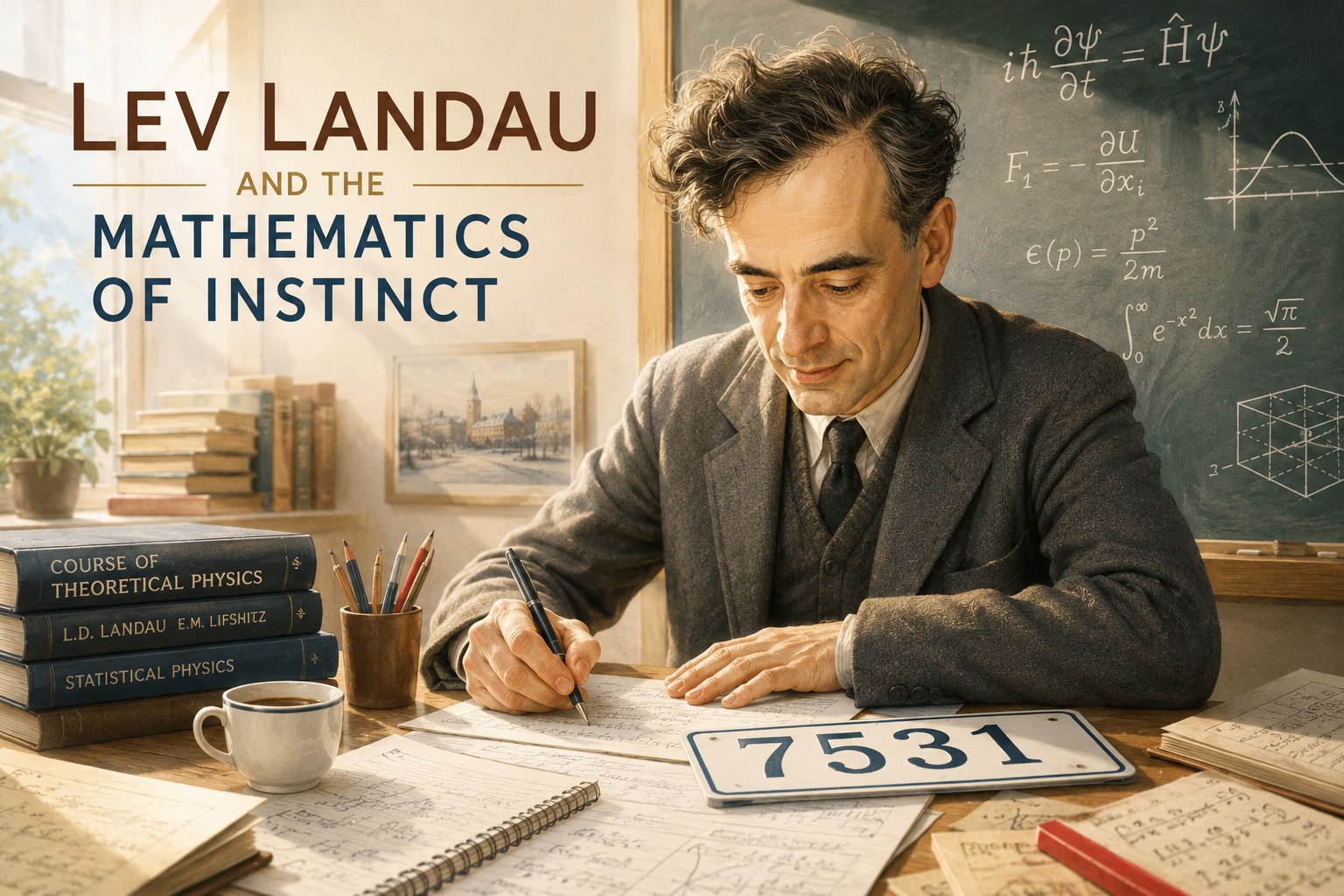
Lev Landau and the Mathematics of Instinct
In Soviet universities, students spoke about Lev Landau almost the way medieval scholars spoke about legendary mathematicians.
Some stories were exaggerated.
Others were probably true.
And sometimes nobody could tell the difference.
Few physicists of the twentieth century acquired an intellectual aura quite like Lev Davidovich Landau. To physicists, he was one of the great architects of modern theoretical physics — Nobel laureate, creator of a research school that shaped Soviet science for decades, co-author of one of the most formidable scientific series ever written. To students, however, he became something stranger: a man whose mathematical intuition seemed to operate at a different speed from ordinary thought.
Stories about him circulated through Soviet universities with the intensity of mythology. What made them compelling was not the achievements themselves — those were documented, verifiable, impressive in the ordinary way of great careers. What fascinated people was the texture of his thinking. The sense that for Landau, mathematics was not something you did. It was something you saw.
One small game, improbably, illuminates this better than any biography.
The License Plate Game
The game was simple to state. Take the four digits of an ordinary vehicle license plate, keep them in their original order, and insert mathematical operations between them to produce a valid equality.
A plate reading 7531 might yield:
7 − 5 = 3 − 1
A plate reading 2916 might become:
2 × 9 = 1 + 6 + 11
or something more inventive, depending on which operations you allowed. The standard version permitted addition, subtraction, multiplication, division, exponentiation, factorials, roots, and standard functions — essentially anything a capable secondary school student would recognize.
At first glance the game sounds recreational, almost trivial. A puzzle for idle moments in a car. But beneath it lies something worth taking seriously: the search for hidden relational structure inside sequences that appear arbitrary. Any four digits, taken at random, carry no obvious mathematical meaning. The game asks whether meaning can always be found — whether structure is always there, waiting, if you know how to look.
Landau was astonishingly good at it. According to students and colleagues, he could often produce valid constructions almost instantly, as though the numerical relationships became visible to him before any deliberate search had begun. He did not appear to calculate. He appeared to recognize.
What Recognition Means
The distinction between calculation and recognition is not merely poetic. It corresponds to something real in cognitive science.
When a chess grandmaster looks at a board position, they do not evaluate each possible move through exhaustive analysis — the search space is too large for that approach to work in any reasonable time. Instead, years of immersion have built in them an enormous library of patterns: configurations that carry immediate meaning, positions that feel strong or weak before any explicit reasoning has occurred. The grandmaster sees the position the way a fluent reader sees a sentence — not as a sequence of elements to be decoded one by one, but as a unified structure with immediate significance.
Something analogous happens in mathematics. A student encountering a difficult integral approaches it procedurally — trying known techniques, substituting variables, checking standard forms. A mathematician who has spent years inside that domain encounters the same integral and often simply knows what class of transformation will work. The knowledge is not less rigorous for being fast. It is the residue of an enormous amount of prior deliberate work, compressed into something that functions like perception.
Landau's speed with the license plate game was not magic. It was the visible surface of a mind that had spent decades immersed in mathematical structure — one in which pattern recognition had been trained so deeply that it operated below the level of conscious procedure.
The Boundary of Intuition
What makes the license plate game philosophically interesting is not that Landau was good at it, but that it has a definite mathematical boundary — and his intuition initially placed him on the wrong side of it.
Landau instinctively believed that some four-digit sequences could not be resolved into valid equalities. Certain combinations simply resisted solution no matter how he approached them. His intuition told him that universal solvability was unlikely.
He was wrong.
The mathematician Yu. Gangel eventually proved that a general constructive method exists. The key insight involved trigonometric identities and inverse functions, which extend the space of available operations dramatically. Consider that for any integer , the identity
can in principle be used to represent arbitrary integers through combinations of a fixed set of operations applied repeatedly. The precise construction is technical, but the consequence is clear: given sufficient expressive power in the permitted operations, any four digits can be connected into a valid mathematical statement.
Gangel's theorem did not merely solve the puzzle. It dissolved it. The game, which depended on the possibility of failure, lost a crucial dimension the moment universal solvability was established. The hunt for hidden structure became, in principle, guaranteed — and a guaranteed hunt is no longer a hunt.
The Paradox at the Center
This is where the license plate game opens into something deeper.
Mathematics is, among other things, the systematic replacement of mystery with understanding. A theorem takes something that was uncertain — something that required search, intuition, the possibility of failure — and converts it into something necessary. After Gangel's proof, the question "can this plate be solved?" is no longer interesting. The answer is always yes, and the proof tells you why.
But something is lost in that transaction. Not rigor. Not truth. Something harder to name — the particular quality of attention that arises when an outcome is genuinely unknown. Landau's enjoyment of the game depended partly on the possibility that he might fail. His intuition was interesting precisely because it could be wrong.
This paradox runs through mathematics more broadly. The solved problem is more valuable than the unsolved one, in the sense that it contributes knowledge. But the unsolved problem is in some ways more alive — it demands more of the mind, it sustains a particular kind of engagement that certainty cannot.
Hilbert understood this when he compiled his famous list of unsolved problems in 1900. He was not merely cataloguing difficulties. He was trying to preserve, in an era of rapid mathematical progress, the sense that the discipline still had genuine open territory — places where intuition mattered because the outcome was not yet fixed.
The Course of Theoretical Physics
The same tension appears in Landau's most enduring work.
The Course of Theoretical Physics, written with Evgeny Lifshitz over decades, is one of the most compressed scientific texts ever produced. Its ten volumes cover classical mechanics, field theory, quantum mechanics, statistical physics, fluid dynamics, and more — and they do so with a mathematical density that remains intimidating to working physicists generations later.
Reading Landau & Lifshitz, physicists sometimes describe the experience of encountering a derivation that spans half a page where they would need five — and then, after working through it carefully, realizing that no step is missing. Every omitted line is omitted because it is genuinely obvious, from a certain vantage point. The compression is not carelessness. It is the record of a mind that had internalized so much structure that intermediate steps became invisible, the way an experienced driver no longer consciously processes the act of changing gears.
The books are famous partly for this quality. They do not explain mathematics to the reader. They show mathematics being used — fluently, efficiently, without ceremony — and ask the reader to keep up. They are, in this sense, less like textbooks and more like master classes in mathematical perception.
What Prolonged Immersion Does to a Mind
It is tempting to explain figures like Landau through the vocabulary of genius — innate gifts, exceptional intelligence, faculties unavailable to ordinary people. This explanation is not entirely wrong, but it is incomplete in an important way.
What the evidence suggests is that extreme mathematical fluency is substantially the product of extended immersion in abstract structure, combined with what psychologists call deliberate practice — not mere repetition, but the specific kind of effortful engagement with difficult problems that progressively builds and refines pattern recognition.
The chess grandmaster's positional judgment is built over tens of thousands of hours of studied play. The musician's ability to hear harmonic structure in a complex chord develops through years of careful listening and analysis. Landau's intuition — his ability to see the license plate solution, to derive the result faster than explanation could follow, to compress theoretical physics into half a page — was the accumulated residue of a life in which mathematics had been the primary mode of engaging with reality.
This is not a deflating observation. If anything, it is a more remarkable one. It says that what looks like supernatural perception is in fact something stranger: ordinary human cognition, operating on an extraordinary diet of structure, gradually reshaped into something that functions like a new sense.
The Mathematics of Instinct
Landau did not experience the license plate game as a recreational puzzle. He experienced it as a microcosm of what mathematics always is: the discovery that apparent randomness conceals structure, that sequences which seem arbitrary yield to the right kind of attention, that the world — numerical, physical, formal — is more organized than it first appears.
That conviction drove everything: the research school he built, the course he wrote with Lifshitz, the examinations he made legendarily difficult, the probability problem that disturbed him until he had resolved it to his own satisfaction. The unresolved problem was not just an intellectual inconvenience. It was a gap in his perception — a place where structure had not yet become visible — and the gap was uncomfortable in the specific way that only someone who habitually sees structure can be uncomfortable by its absence.
Gangel's proof established that the gap in the license plate game was illusory: the structure was always there, reachable by methods Landau's intuition had not fully explored. The mystery dissolved. The game became trivial.
But the question the game had briefly made vivid — whether structure is always there, whether every apparent randomness conceals a pattern that the right kind of attention can find — did not dissolve with it.
That question is older than the game, older than Landau, older than formal mathematics.
It is, in some sense, the question that mathematics exists to answer.
And it remains, in the most interesting cases, permanently open.
EisatoponAI
An independent intellectual publication exploring mathematics, AI, science, paradoxes, and the hidden structures behind reality.