
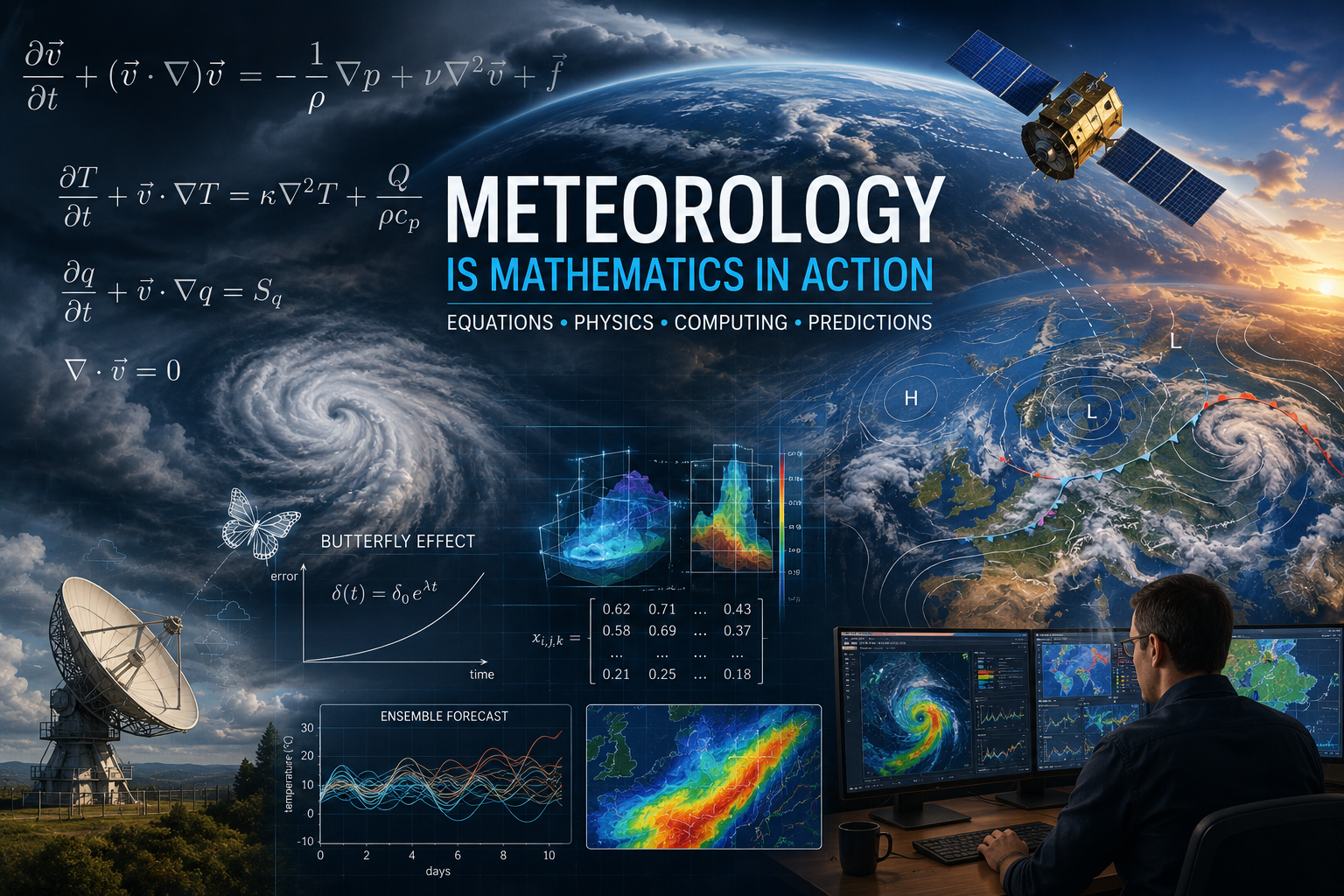
Meteorology Is NOT Just Weather Forecasting
Most people think Meteorology is simply about looking at clouds and saying:
“Tomorrow it will probably rain.”
Reality is far more fascinating.
Modern Meteorology is one of the most mathematically sophisticated sciences in existence.
Every weather forecast is actually the result of:
- advanced physics,
- enormous systems of equations,
- probability theory,
- computational mathematics,
- and some of the most powerful supercomputers on Earth.
Behind the simple phrase:
“70% chance of rain”
lies an extraordinary mathematical universe.
The Atmosphere Is a Giant Mathematical System
The atmosphere is not random chaos.
It follows physical laws.
The problem is that these laws interact in unbelievably complicated ways.
Meteorologists attempt to predict:
- temperature,
- pressure,
- humidity,
- wind,
- cloud formation,
- storms,
- ocean interactions,
- and energy transfer
across the entire planet simultaneously.
This means solving gigantic mathematical systems continuously in time.
The Equations Behind Weather
At the heart of modern weather prediction are the famous fluid dynamics equations known as:
Navier–Stokes Equations
These equations describe how fluids move.
Since the atmosphere behaves like a gigantic fluid, they become fundamental to weather prediction.
A simplified symbolic form looks like:
:contentReference[oaicite:0]
This single equation already contains:
- velocity fields,
- pressure gradients,
- viscosity,
- external forces,
- and nonlinear interactions.
And this is only part of the system.
Meteorology also requires:
- thermodynamics,
- conservation laws,
- radiation equations,
- moisture equations,
- turbulence models.
Why Weather Prediction Is So Difficult
The atmosphere is what mathematicians call a:
chaotic system.
Tiny changes in initial conditions can produce dramatically different outcomes later.
This phenomenon became famous through:
The Butterfly Effect
popularized by meteorologist Edward Lorenz.
Even microscopic measurement errors can grow exponentially over time.
Mathematically, chaotic growth is often described by exponential divergence:
:contentReference[oaicite:1]
where:
- ( \delta_0 ) is a tiny initial error,
- and ( \lambda ) measures how quickly uncertainty grows.
This is why weather forecasts become increasingly unreliable after about:
- 7 days,
- 10 days,
- sometimes even earlier.
The atmosphere is simply too sensitive.
The Forecast You See Is Not Just One Simulation
Modern forecasting centers rarely rely on a single prediction.
Instead, they run:
Ensemble Forecasts
Dozens — sometimes hundreds — of simulations are performed simultaneously.
Each simulation starts with slightly different initial conditions.
The goal is not just:
“What will happen?”
but rather:
“What is the probability of different outcomes?”
This is why modern forecasts increasingly use probabilities rather than absolute certainty.
The Role of Supercomputers
Weather prediction is computationally enormous.
Organizations such as:
- ECMWF (European Centre for Medium-Range Weather Forecasts),
- NOAA,
- Meteo-France,
- UK Met Office
operate some of the most powerful supercomputers in the world.
These systems perform:
- billions,
- sometimes trillions
of calculations every second.
The Earth’s atmosphere is divided into massive three-dimensional grids.
For every tiny region, the models continuously calculate:
- temperature,
- pressure,
- wind velocity,
- moisture,
- energy exchange.
Then they repeat the process again and again for future time steps.
Meteorology and Artificial Intelligence
In recent years, AI has entered weather forecasting dramatically.
New systems such as:
- GraphCast (Google DeepMind),
- Pangu-Weather,
- FourCastNet
use deep learning instead of traditional physics-only simulations.
Some AI models can already:
- produce forecasts much faster,
- reduce computational cost,
- and sometimes outperform classical models in specific tasks.
This is one of the most exciting scientific developments of the decade.
AI is not replacing atmospheric physics.
Instead, it is becoming a new mathematical layer on top of it.
Why Meteorology Is Beautiful Mathematics
Meteorology is fascinating because it connects abstract mathematics directly to daily life.
Differential equations suddenly become:
- storms,
- hurricanes,
- snowfall,
- heatwaves,
- clouds over your city.
Chaos theory becomes visible in real time.
Probability becomes tomorrow’s forecast.
Very few sciences connect pure mathematics to reality so vividly.
What Mathematics Does Meteorology Actually Use?
Modern Meteorology relies heavily on:
Partial Differential Equations
Fluid motion, heat transfer, atmospheric dynamics.
Numerical Analysis
Approximating solutions impossible to solve analytically.
Linear Algebra
Massive matrix computations inside weather models.
Probability & Statistics
Uncertainty estimation and ensemble forecasting.
Dynamical Systems & Chaos Theory
Sensitivity to initial conditions.
Machine Learning
Pattern recognition and AI-assisted forecasting.
Why Forecasts Sometimes Fail
People often criticize meteorologists when forecasts change.
But forecasting the atmosphere is fundamentally difficult.
A tiny atmospheric disturbance over:
- the Atlantic,
- North Africa,
- or the Arctic
can alter weather patterns across Europe several days later.
Forecasting is not magic.
It is an ongoing battle against chaos itself.
A Hidden Mathematical Wonder
The next time you see a weather forecast on television, remember:
Behind that colorful map are:
- nonlinear equations,
- chaotic systems,
- probability distributions,
- supercomputers,
- and some of the most advanced mathematics humans use every day.
Meteorology is not “just weather.”
It is applied mathematics in action.
And perhaps one of the most beautiful examples of mathematics interacting directly with the real world.
Conclusion
Meteorology sits at the crossroads of:
- Mathematics,
- Physics,
- Computer Science,
- Artificial Intelligence,
- and Earth Science.
It transforms abstract equations into predictions about the world around us.
That is what makes it extraordinary.
The atmosphere may appear simple when we look at the sky.
But mathematically, it is one of the most complex systems humanity has ever attempted to understand.