
Meteorology Is Not Just Weather Forecasting
When a forecast says "70% chance of rain tomorrow," most people experience it as a guess — an educated one, perhaps, but fundamentally imprecise, the meteorologist's way of hedging against uncertainty.
The reality is almost the opposite. That single number is the compressed output of one of the most mathematically sophisticated operations humanity performs routinely. Behind it are differential equations that describe fluid motion across an entire planet, numerical algorithms running on machines that perform billions of calculations per second, and a probabilistic framework that deliberately incorporates the limits of what physics can predict. The imprecision is not a failure of meteorology. It is what rigorous meteorology looks like when it encounters a system that is, in a precise mathematical sense, fundamentally chaotic.
Understanding why reveals something remarkable: the sky above your city is, at every moment, a partial differential equation being solved in real time.
The Atmosphere as a Mathematical Object
The atmosphere is not random. It obeys physical laws — conservation of mass, conservation of momentum, conservation of energy — applied simultaneously across an enormous, three-dimensional, continuously evolving fluid system.
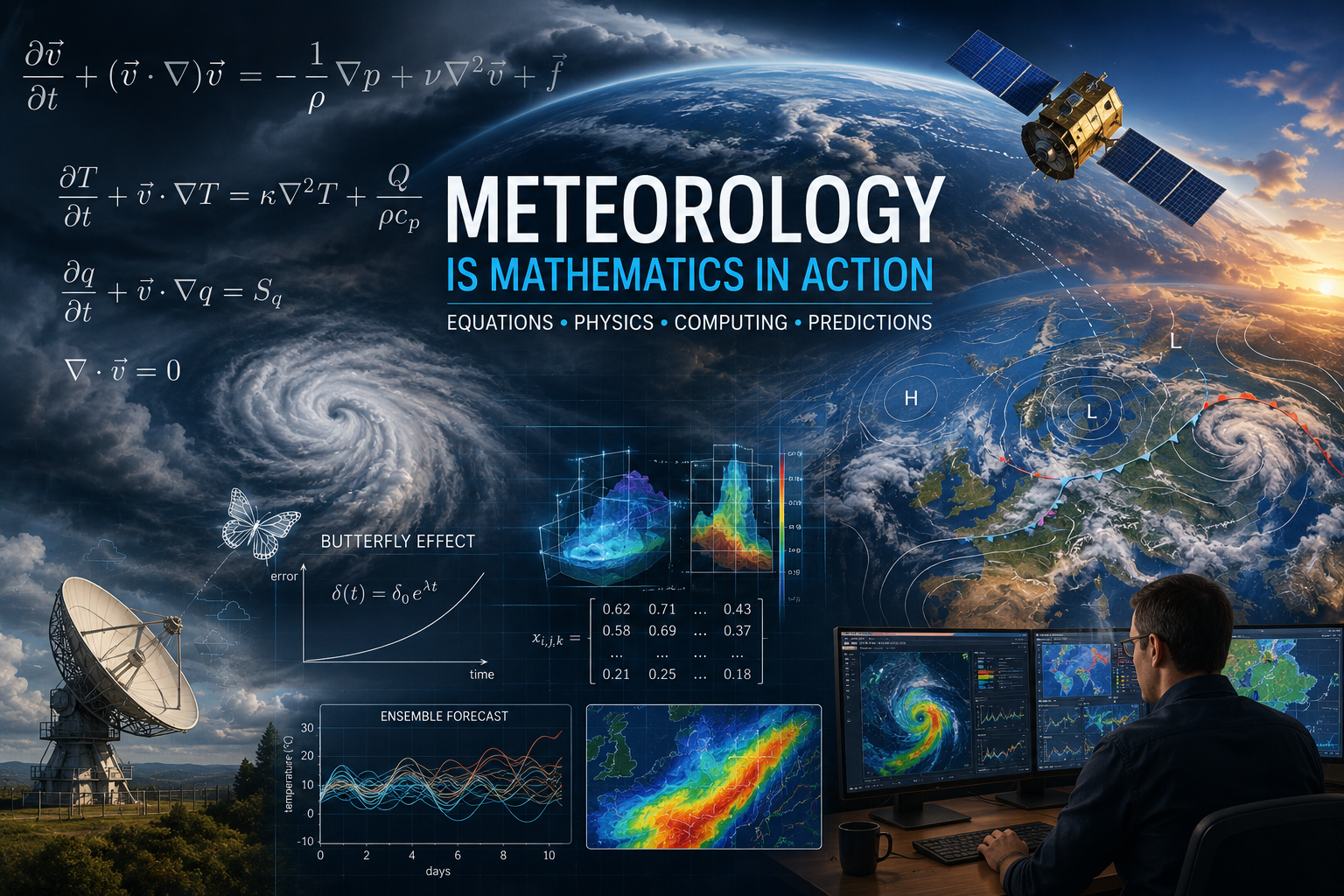
The governing equations of atmospheric motion are versions of the Navier–Stokes equations, the fundamental description of how fluids move. In the form relevant to meteorology, the momentum equation for a fluid parcel in the atmosphere takes the shape:
where is the wind velocity field, is air density, is pressure, is gravitational acceleration, is the force introduced by Earth's rotation, and accounts for viscous dissipation.
This single equation is coupled to a thermodynamic equation governing temperature, a continuity equation governing density, an equation of state connecting pressure, density, and temperature, and additional equations for water vapor, cloud formation, and radiative energy transfer. Taken together, these form a system of nonlinear partial differential equations with no general analytical solution. You cannot solve them the way you solve a quadratic equation — writing down a formula and evaluating it. You can only approximate them numerically, stepping forward through time in discrete increments, updating the state of the atmosphere across a vast computational grid at each step.
This is what weather prediction actually is: numerical integration of a coupled nonlinear PDE system, repeated billions of times, across a planet.
Why the Problem Is Genuinely Hard
The Navier–Stokes equations are nonlinear. That single word carries enormous consequences.
In a linear system, small causes produce small effects in proportion. Double the input, double the output. Errors stay bounded. Predictions remain reliable over long time horizons. Linear systems are, in a deep sense, forgiving.
Nonlinear systems are not. They allow small perturbations to interact with themselves and with other perturbations in ways that amplify rather than decay. This is the mathematical foundation of chaos — and the atmosphere is a chaotic system in the precise technical meaning of the term.
Edward Lorenz discovered this in 1961, in circumstances that have since become famous. Running a weather simulation for a second time, he restarted it midway through by entering a rounded value — instead of the full . The two simulations, identical at the start and differing by less than one part in a thousand, produced completely different weather patterns within a simulated month. The rounding error had not decayed. It had grown, exponentially, until it dominated the prediction entirely.
The mathematics of this growth is described by Lyapunov exponents. In a chaotic system, the separation between two initially close trajectories grows approximately as:
where is the initial separation, is the largest Lyapunov exponent, and is time. For the atmosphere, is such that errors roughly double every two to five days. An initial measurement error of one part in a million becomes an error of order one — meaning the prediction is essentially useless — in approximately two to three weeks.
This is not a technological limitation. It is not a problem that better instruments or faster computers can fully overcome. It is a structural property of the equations themselves. The atmosphere is, in Lorenz's phrase, sensitively dependent on initial conditions — and no finite measurement of a continuous system can eliminate initial uncertainty entirely.
The practical consequence is the horizon you have probably noticed: forecasts beyond about seven days become progressively less reliable not because meteorologists are incompetent, but because the physics guarantees it.
How Modern Forecasting Responds: Ensemble Methods
The response to chaos is not to pretend it doesn't exist. It is to make it mathematically explicit.
Modern forecasting centers do not run a single simulation and report its output. They run ensemble forecasts — typically between fifty and a hundred simulations simultaneously, each starting from slightly different initial conditions that collectively span the uncertainty in current atmospheric measurements.
If all fifty simulations produce similar outcomes — a high-pressure system persisting over northern Europe, say — the forecast carries high confidence. If the simulations diverge dramatically after three days, with some producing rain and others sunshine, the forecast carries low confidence, and this uncertainty is reported directly as a probability distribution over outcomes rather than a single prediction.
The European Centre for Medium-Range Weather Forecasts (ECMWF), widely regarded as operating the world's most accurate medium-range forecast system, divides the atmosphere into a three-dimensional grid with horizontal resolution of approximately nine kilometers and fifty vertical levels. At each grid point, at each time step, the model integrates the coupled PDE system forward — updating temperature, pressure, wind velocity, humidity, and dozens of derived quantities. A single ten-day global forecast requires roughly floating-point operations.
That number — a quadrillion arithmetic operations — is performed in under an hour on a machine with hundreds of thousands of processor cores.
The January 2009 Lesson
The abstract argument for ensemble forecasting becomes vivid in specific cases.
In January 2009, an unusually complex atmospheric pattern developed over the North Atlantic. Single-model deterministic forecasts — the kind that produce one predicted outcome — disagreed sharply with each other depending on small differences in how the initial state was analyzed. Some predicted a major storm track across central Europe. Others predicted a blocking pattern that would divert the storm northward.
The ensemble forecast, by running many simulations across the range of plausible initial states, captured both scenarios — and assigned probabilities to each. The probability distribution it produced was not a failure to commit. It was an accurate representation of what the physics, given the uncertainty in initial conditions, actually implied. The single-model forecasts, by contrast, committed to one scenario and were simply wrong about which one would verify.
This is the deeper point about probabilistic forecasting: the probability is not an expression of meteorological doubt. It is the mathematically correct answer to the question the atmosphere is actually asking.
Artificial Intelligence Enters the System
In the last three years, something unexpected has happened to weather forecasting.
Machine learning models — trained not on physical equations but on decades of historical forecast data and observations — have begun producing medium-range forecasts that rival or occasionally exceed the accuracy of traditional physics-based systems, at a fraction of the computational cost.
Google DeepMind's GraphCast, released in 2023, produces ten-day global forecasts in under a minute on a single machine that would require hours of supercomputer time using conventional methods. Huawei's Pangu-Weather and NVIDIA's FourCastNet have demonstrated similar capabilities. In benchmark comparisons against ECMWF's operational system, these models perform competitively on standard skill metrics and outperform classical models on certain specific tasks, particularly the prediction of extreme events.
What makes this scientifically interesting is the mechanism. These models have not been taught Navier–Stokes. They have not been given thermodynamic equations or Coriolis force corrections. They have learned, purely from statistical patterns in enormous datasets, to predict atmospheric states in ways that implicitly capture the physics the equations describe — because the physics is present in the data.
This is not magic, and it does not mean the physical understanding is dispensable. AI forecast models fail in systematic ways that physical understanding can diagnose and correct. They can produce meteorologically implausible states that a physics-based model would never generate. They are not reliable outside the distribution of their training data, which means that in a changing climate, their accuracy may degrade in precisely the situations where accurate forecasting matters most.
The emerging picture is not AI replacing atmospheric physics but AI and physics operating as complementary mathematical layers — the equations providing physical consistency and interpretability, the learned models providing speed and the ability to extract patterns from data that the equations alone would miss.
The Butterfly and the Equation
There is a recurring image in explanations of chaos theory: a butterfly flapping its wings in Brazil setting off a tornado in Texas. Lorenz himself used it, though with appropriate irony — he knew the image was a simplification of a mathematical statement, not a literal claim about butterflies.
The genuine claim is more interesting and more precise. It is that in a nonlinear dynamical system, the future state depends continuously and sensitively on the initial state, and that this sensitivity grows exponentially with time. The butterfly is a metaphor for the measurement error you can never fully eliminate — the last decimal place you cannot know, the atmospheric eddy too small to observe, the ocean temperature measured to the nearest tenth of a degree rather than the nearest millionth.
What Lorenz showed is that this irreducible uncertainty is not a minor correction to an otherwise predictable system. In a chaotic system, it is the system. The uncertainty is not in our instruments. It is in the mathematics.
This is what makes meteorology one of the most philosophically interesting applications of mathematics in science. It is a domain where perfect physical understanding of the equations does not translate into perfect prediction — where knowing the laws completely does not allow you to know the future completely, because the laws themselves guarantee that small ignorance becomes large ignorance faster than measurement can keep up.
The atmosphere obeys mathematics with perfect fidelity. It is simply solving equations that are, in principle, beyond exact prediction.
What the Forecast Actually Tells You
The next time you look at a weather app and see a percentage, consider what it represents.
Somewhere, a supercomputer has integrated a coupled system of nonlinear partial differential equations forward through time, starting from an initial atmospheric state assembled from millions of surface observations, radiosonde balloon measurements, satellite retrievals, and aircraft reports, processed through a data assimilation system that itself involves sophisticated linear algebra and optimization theory. It has done this dozens of times simultaneously, with slightly different starting points, and summarized the spread of outcomes as a probability over discrete weather categories.
The number you see is the output of that process compressed into a single figure. It is not a guess. It is the mathematically rigorous answer to a question the physics of the atmosphere makes genuinely probabilistic.
Meteorology does not fail to predict the future. It succeeds at predicting the probability distribution of the future — which is, for a chaotic system, the only honest thing physics allows.
That is what makes it extraordinary. And that is why the sky, for anyone paying attention to the mathematics underneath it, remains one of the most astonishing objects of scientific inquiry in existence.
EisatoponAI
An independent intellectual publication exploring mathematics, AI, science, paradoxes, and the hidden structures behind reality.