
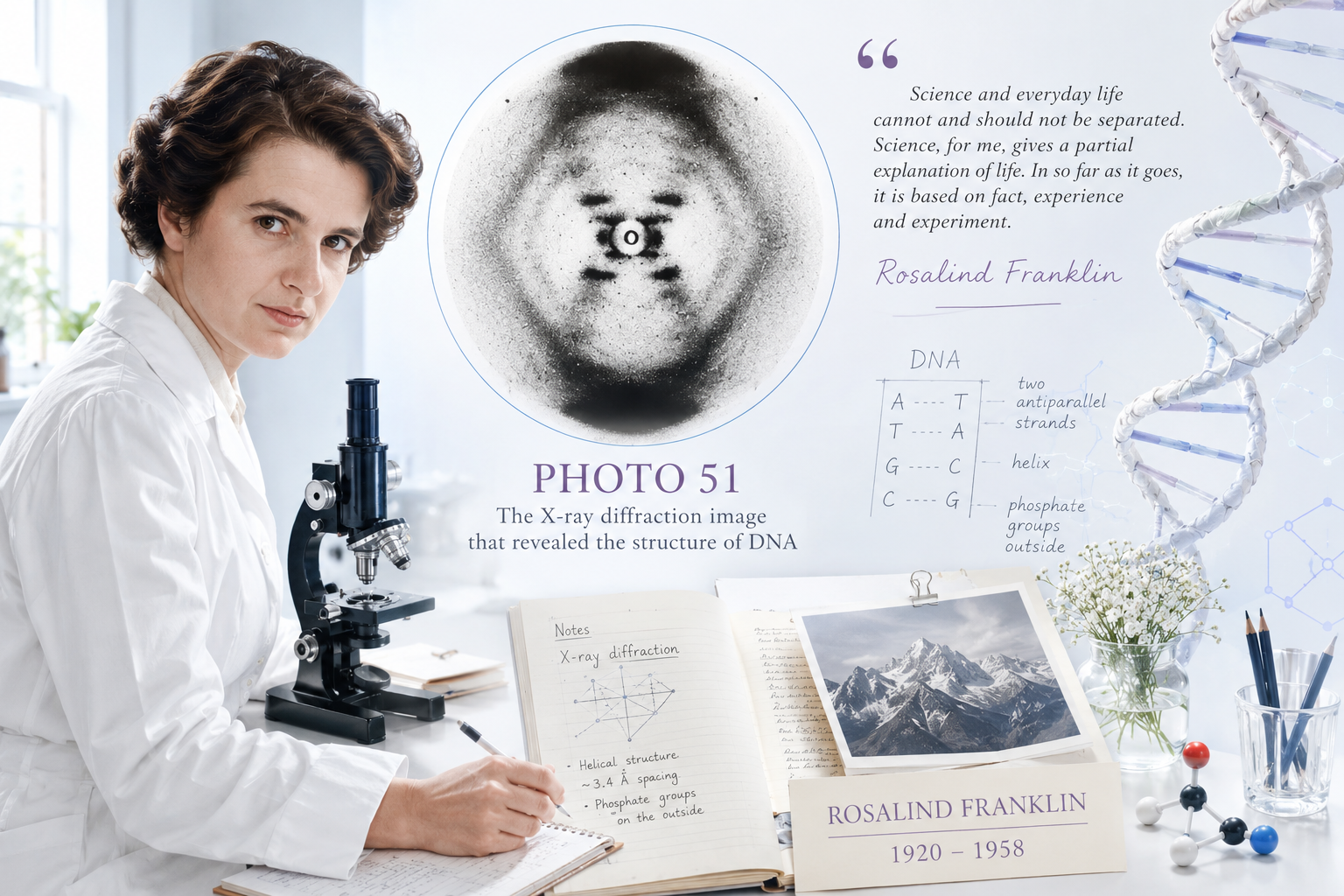
Rosalind Franklin and the Photograph That Changed Biology
In a laboratory filled with shadows, radiation, and silence, a woman captured the architecture of life itself — and the world almost forgot her name.
In the early 1950s, inside the walls of King’s College London, Rosalind Franklin worked with extraordinary precision and relentless discipline.
Hour after hour, she exposed delicate biological samples to powerful X-rays, searching for patterns invisible to the human eye.
The work was exhausting.
Slow.
Dangerous.
She did not know that one of the images produced in that laboratory would become one of the most important scientific photographs in history.
It would later be known simply as:
Photo 51
The Woman Behind the Image
Rosalind Franklin was not the stereotype many people imagine when they think of scientific fame.
She was reserved but intense. Elegant but uncompromising.
Friends described her as brilliant, demanding, sharp-minded, and deeply committed to truth.
Outside the laboratory, she loved hiking, mountains, travel, and nature. Inside it, she pursued scientific accuracy with near-absolute seriousness.
But the environment surrounding her was deeply hostile to women.
At King’s College London, the scientific culture remained rigidly hierarchical and overwhelmingly male.
Franklin was often treated not as an equal researcher, but as an outsider.
Tensions with Maurice Wilkins became especially significant.
Without Franklin’s permission, Wilkins showed one of her X-ray diffraction images to James Watson.
That image changed everything.
The Ghost Photograph
Photo 51 did not look revolutionary at first glance.
It was grainy. Abstract. Almost ghost-like.
But to trained scientific eyes, the image contained something extraordinary.
At its center appeared a distinct X-shaped pattern.
That shape revealed a hidden truth:
the molecule of DNA possessed a helical structure.
Watson immediately understood the importance of what he was seeing.
Within weeks, Watson and Francis Crick finalized the model of the DNA double helix.
In 1953, the structure of DNA was announced to the world.
Modern biology would never be the same again.
The Geometry of Life
What makes Photo 51 so extraordinary is that it was not merely a photograph.
It was mathematics made visible.
Franklin’s work relied on X-ray crystallography — a technique in which radiation passes through molecular structures and creates diffraction patterns containing geometric information.
The image itself was a coded map of invisible order.
From those patterns, scientists could infer:
- symmetry,
- spacing,
- molecular orientation,
- and three-dimensional structure.
The famous X-shape was not accidental.
It was geometry revealing the hidden architecture of life.
Franklin had already correctly inferred several crucial properties of DNA:
- that the molecule was helical,
- that phosphate groups lay on the exterior,
- and that the structure possessed precise repeating dimensions.
Her conclusions emerged not from speculation, but from extraordinary scientific rigor.
Science, Recognition, and Silence
In 1962, James Watson, Francis Crick, and Maurice Wilkins received the Nobel Prize for the discovery of the structure of DNA.
Rosalind Franklin was absent.
She had died four years earlier, in 1958, at the age of just 37.
The cause was ovarian cancer.
Many historians and scientists believe that her prolonged exposure to X-ray radiation may have contributed significantly to her illness.
Because Nobel Prizes are not awarded posthumously, Franklin could never be officially recognized alongside the others.
Yet over time, the scientific world began to reconsider the story.
Not merely because she had been overlooked — but because her contribution was foundational.
Without Franklin’s data, the double helix model could not have emerged in the form it did.
Beyond the Myth
It is tempting to reduce Rosalind Franklin’s story to a simple narrative of injustice.
But that would diminish something essential about her.
She was not important merely because she was excluded.
She was important because she was exceptional.
Her work displayed extraordinary precision, intellectual discipline, and scientific integrity.
She saw structure where others saw noise.
She transformed scattered diffraction patterns into understanding.
And in doing so, she helped reveal one of the deepest secrets in nature: the mechanism through which life stores and transmits information.
The Photograph That Revealed Ourselves
There is something almost poetic about Photo 51.
A blurry image produced through invisible radiation became humanity’s first clear glimpse into its own biological code.
Inside that ghostly X-shaped pattern lay:
- heredity,
- evolution,
- disease,
- memory,
- identity,
- and the continuity of life itself.
The photograph did not merely reveal DNA.
It revealed that life possesses structure.
That biology contains geometry.
That living organisms are built upon patterns precise enough to be read.
Rosalind Franklin’s Philosophy
Franklin herself once wrote:
“Science and everyday life cannot and should not be separated. Science, for me, gives a partial explanation of life. In so far as it goes, it is based on fact, experience and experiment.”
The sentence captures her perfectly.
Calm. Precise. Unsentimental.
Yet profoundly devoted to understanding reality.
Recognition After Silence
Today, Rosalind Franklin is increasingly recognized as one of the great scientific minds of the twentieth century.
Not as a forgotten footnote.
Not as a symbol alone.
But as a scientist whose work fundamentally changed humanity’s understanding of life.
Photo 51 remains one of the most important images ever produced.
A fragile pattern of light and shadow that revealed the hidden symmetry inside every living cell.
And behind that image stood a woman who saw farther than almost anyone around her — even when history itself struggled to see her.
Published by EisatoponAI
EisatoponAI is an independent intellectual publication exploring mathematics, science, paradoxes, AI, philosophy, and the hidden structures behind reality.
Calm, elegant, and deeply curious — designed for readers who want more than information.