
Tetris: The Soviet Mathematical Experiment That Conquered the Human Brain
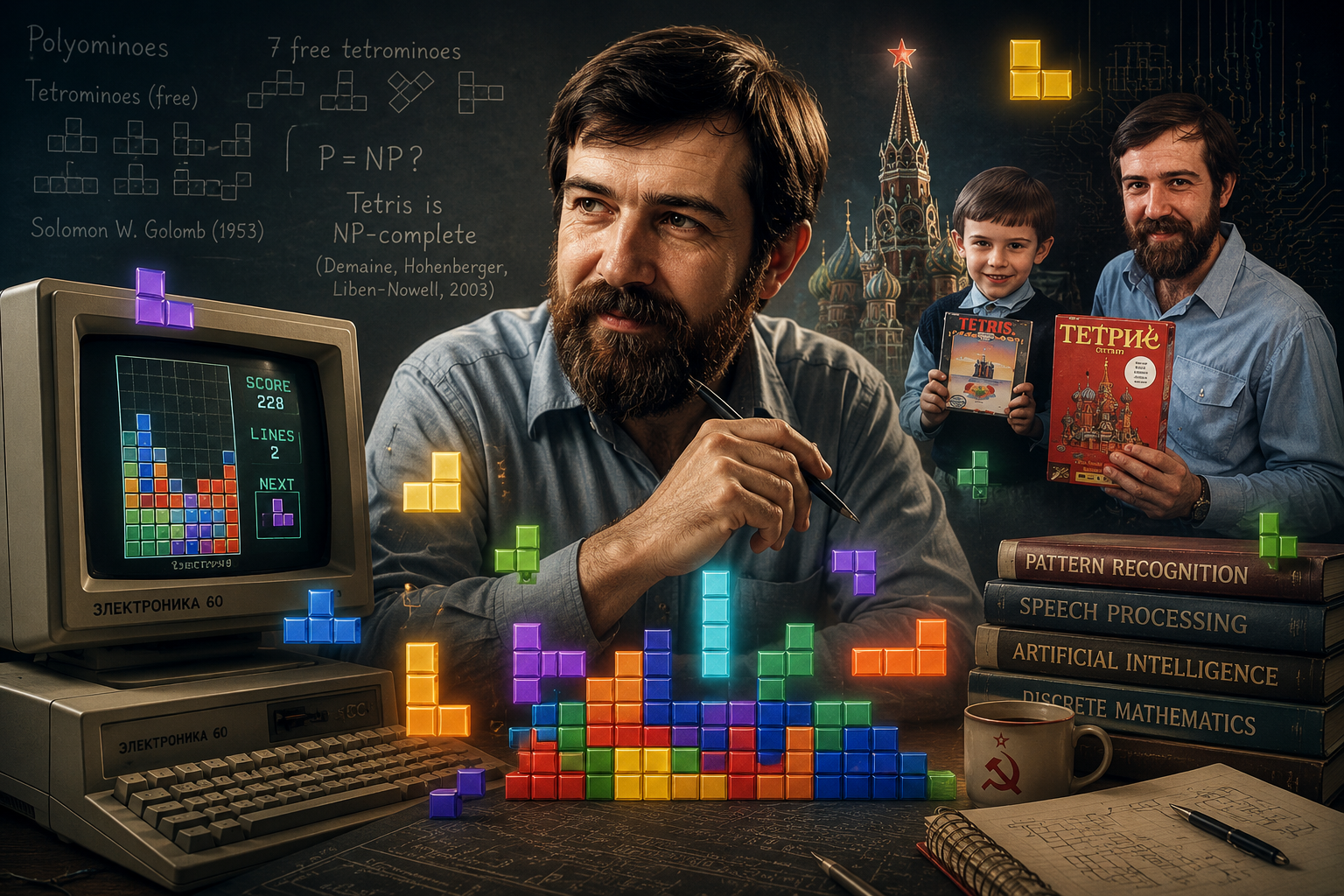
On June 6, 1984, Alexey Pajitnov sat at an Electronika 60 computer in the Dorodnitsyn Computing Centre of the Soviet Academy of Sciences in Moscow and wrote a game. The computer had no graphics card. The blocks on screen were made of keyboard bracket characters. The purpose of the program was not to create a game — it was to benchmark the machine.
Pajitnov was a mathematician and software engineer assigned to test new hardware as it arrived from outside the Soviet Union. His method was to write small programs that stressed different computational capacities. For this particular test, he drew on a puzzle from his childhood: pentominoes, the five-square geometric shapes that are notoriously difficult to fit back into their box once removed. He simplified the pieces to four squares each, to reduce the computational load, and created a falling-block mechanic to generate continuous variation.
The result was immediately, viscerally addictive. Pajitnov later admitted that he would pretend to be busy with official work while actually playing his own game. His colleagues did the same. Within weeks, the program had spread across the institute on floppy disks — a form of distribution that in the Soviet Union required no packaging, no marketing, and no payment to anyone.
Tetris had not been designed. It had been discovered.
The Mathematics Behind the Blocks
The falling pieces of Tetris are not arbitrary shapes. They are the complete set of tetrominoes — all geometrically distinct ways to join four unit squares edge-to-edge, when rotations and reflections are treated as equivalent.
Tetrominoes belong to a family of mathematical objects called polyominoes, systematically studied by mathematician Solomon W. Golomb in the 1950s. A polyomino is formed by joining unit squares along their edges. For , the count of distinct free polyominoes — those where you can rotate or flip the shape and still count it once — is exactly seven. No more, no less. The seven Tetris pieces are not a design choice. They are combinatorial geometry.
The completeness of this set has direct consequences for gameplay. Together, the seven tetrominoes tile the plane — they can, in principle, fill a flat surface without gaps. But whether any given sequence of pieces can be arranged to clear rows without leaving holes depends on the order in which they arrive, the choices the player makes, and the geometry of what has accumulated below. This is where the mathematics gets genuinely deep.
A useful observation: the I, O, S, Z, T, L, and J pieces have different parity properties under the checkerboard coloring of the grid. The S and Z pieces, in particular, create a structural tension — they introduce gaps that are difficult to fill without generating imbalance. This is not accidental. It is why experienced players speak of S/Z pieces with particular anxiety. The geometry encodes a bias.
The Computational Complexity of Perfect Play
Here is a result that surprises most people: for a generalized version of Tetris — played on a board of arbitrary width, with an arbitrary sequence of tetrominoes — optimal play is computationally intractable.
In 2003, computer scientists Erik Demaine, Susan Hohenberger, and David Liben-Nowell proved that the following decision problem is NP-complete: given a current board configuration and an incoming sequence of tetrominoes, does there exist a strategy for placing them that clears at least rows? They also showed related hardness results: maximizing the number of cleared rows is NP-hard, and determining whether you can survive (avoid the board filling to the top) is also NP-complete.
NP-completeness means, informally, that no efficient algorithm is known to solve these problems in general — and if one were found, it would resolve one of the deepest open questions in mathematics (P vs NP). Verification of a proposed solution is fast; finding the optimal solution may require checking exponentially many possibilities.
The practical consequence: no algorithm — human or machine — can guarantee optimal Tetris play as the board grows and the sequence lengthens. The game is not merely difficult in the way that chess is difficult, where the difficulty comes from the enormous but finite branching factor. Tetris difficulty is structural. The problem belongs to the same complexity class as Boolean satisfiability, the traveling salesman problem, and protein folding. It cannot, in general, be solved efficiently.
This is why Tetris never feels truly mastered. The increasing speed merely forces the player into a regime where computational shortcuts — intuition, heuristics, pattern recognition — must substitute for optimal reasoning, because optimal reasoning is provably too slow.
A Game Born in a System Without Intellectual Property
What happened to Tetris after Pajitnov wrote it is a story about the Soviet system that is as strange as the game itself.
In the Soviet Union of 1984, software created by an employee of a state institute belonged to the state. Intellectual property as a category barely existed. Pajitnov had no mechanism to claim ownership of what he had made. As Tetris spread — first through Soviet research networks, then to Hungary, then to a British software firm called Andromeda that began licensing it without ever having secured the rights, then to Nintendo, which bundled it with the original Game Boy and sold 35 million cartridges of the game alone — Pajitnov continued to receive his normal government salary.
The Soviet state agency tasked with managing foreign licensing of Soviet software, Elorg (Elektronorgtechnica), eventually stepped in to assert control, generating a bidding war for Tetris rights in the late 1980s that involved Nintendo, Atari, and several European publishers simultaneously claiming licenses none of them fully possessed. The legal chaos was partly enabled by the fact that the Soviet system had never developed the infrastructure to manage commercial intellectual property, because commercial intellectual property had not previously been a category that existed.
Through all of this, Pajitnov received nothing. He moved to the United States in 1991, and only in 1996 — twelve years after he created the game — did the original licensing deal expire and the rights revert to him. He and his collaborator Henk Rogers founded The Tetris Company that year. Estimates suggest he lost approximately $100 million in royalties during those twelve years, while the game sold hundreds of millions of copies.
The irony is structural: a game about optimizing the use of limited space, created by a mathematician in a system that left no space for individual ownership of ideas.
What the Game Does to the Brain
Tetris is one of the most studied games in cognitive neuroscience, partly because its demands are so cleanly delineated. It requires simultaneous engagement of spatial reasoning, mental rotation, rapid pattern matching, working memory, and real-time optimization under increasing time pressure. This combination makes it a useful experimental tool — a standardized, controllable cognitive task with measurable difficulty scaling.
In 2009, researchers at the Mind Research Network in Albuquerque led by Richard Haier used MRI scanning to study adolescent girls who played Tetris for thirty minutes a day over three months. The results were striking. Compared to controls, players showed greater brain efficiency — they accomplished the same cognitive work with less measured neural activity, the signature of a skill becoming automated. They also showed increased cortical thickness in specific regions of the left frontal and temporal lobes.
The surprising finding was that the efficiency gains and the structural thickening occurred in different brain areas. How a thicker cortex in one region relates to more efficient processing in another remains, as Haier put it, "a mystery." The game was reshaping brain structure and brain function simultaneously, but not in the same places — suggesting that skill acquisition involves parallel, not sequential, neural reorganization.
The Tetris Effect — the phenomenon in which extended players continue to visualize falling blocks after stopping play, and begin mentally organizing real-world objects into tetromino-like arrangements — is the perceptual complement of this neural reorganization. The game installs a temporary perceptual schema: the brain, having been trained to see the world as a field of shapes to be optimized, keeps applying that framework after the immediate stimulus is removed. Players report dreaming about rotating tetrominoes. Some describe unconsciously scanning grocery shelves or bookshelves for gaps that could be filled. The schema runs below conscious control.
This is, in a precise sense, what mathematical training does more broadly. Prolonged exposure to a formal system reshapes what you notice, what you find salient, what problems you spontaneously see in an environment that was not presented as a problem at all.
Simple Rules, Structural Depth
There is a category of mathematical objects that Tetris exemplifies better than almost any other designed system: problems where the rules are minimal but the state space is effectively inexhaustible.
The rules of Tetris are four: pieces fall from the top, the player can rotate and translate them before they land, completed horizontal rows are cleared, and the game ends when the stack reaches the top. From these four rules, together with the seven tetrominoes and a board of fixed width, emerges a system whose optimal play is NP-hard, whose cognitive demands are sufficient to produce measurable neurological change over months of practice, and whose strategic depth has sustained competitive play for forty years.
This is not a coincidence. It is a consequence of the mathematics being right. The seven tetrominoes are the complete set — not an approximation, not a curated subset, but the exhaustive enumeration of a combinatorial class. The NP-hardness of optimal play means that the game cannot, even in principle, be trivialized by getting better at it. The clearing mechanic creates a feedback structure where local optimization choices propagate into global consequences in ways that resist full anticipation.
Pajitnov was not trying to create this. He was trying to benchmark a computer. The mathematics was already there, implicit in the geometry of four-square polyominoes and the structure of plane tiling problems. What he did was find the minimal game-mechanical wrapper that made those mathematical properties perceptible and engaging to a human player.
The game is not a metaphor for mathematics. It is mathematics — a particular corner of combinatorial geometry and computational complexity theory, compressed into a form that a human being can play in real time and find compelling enough to do for decades.
EisatoponAI
An independent intellectual publication exploring mathematics, AI, science, paradoxes, and the hidden structures behind reality.