
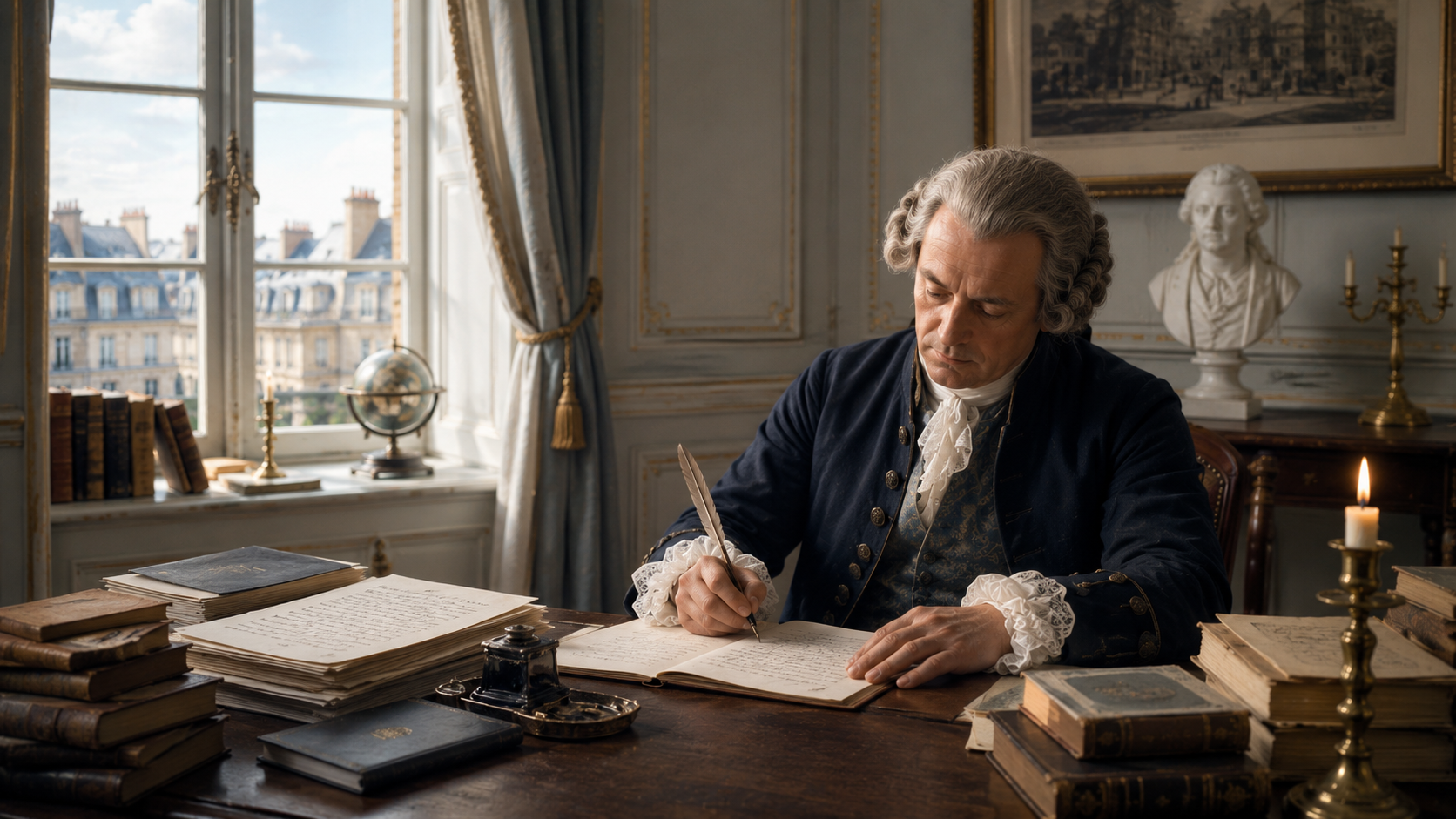
How Ten Minutes a Day Became a Masterpiece
Henri François d'Aguesseau served as Chancellor of France three times between 1717 and 1750, under both Louis XIV and Louis XV. Voltaire called him "the most learned magistrate France ever possessed." He spent decades reforming French jurisprudence, attempted to codify the entire body of French law into a single unified system — a task that proved too vast even for his career — and produced a body of legal and philosophical writing substantial enough to fill sixteen volumes in its most complete posthumous edition.
And then there is the anecdote.
According to an account published in the Journal of Belles Lettres in 1838, d'Aguesseau noticed that his wife consistently arrived ten or twelve minutes late for dinner. Rather than complain or simply wait, he began carrying paper and a pen to the table. Each evening, in those small intervals between sitting down and her arrival, he wrote.
Not for hours. Not with a schedule or a deadline. Only for ten minutes — sometimes twelve — at the end of each working day, while waiting for a meal to begin.
Fifteen years later, those minutes had accumulated into a three-volume work that passed through multiple editions.
The Arithmetic of Small Time
The calculation is straightforward, and worth doing explicitly.
Ten minutes per day, repeated over fifteen years, amounts to approximately 900 hours of writing. That is the equivalent of twenty-two and a half standard forty-hour working weeks — more than five months of full-time work — extracted entirely from moments that would otherwise have been empty.
The compounding effect is not financial here but temporal: d'Aguesseau was not earning interest on his minutes. He was simply refusing to lose them. The mathematics is linear, not exponential. But the gap between a person who captures those minutes and one who does not is, over fifteen years, enormous. Nine hundred hours of focused work is enough to produce a substantial body of scholarship. It is enough to learn a language, master an instrument, or write several books. It does not require any change in the structure of a life — only a different attitude toward the moments that exist between its scheduled parts.
What makes the anecdote striking is not the conclusion but the precondition: d'Aguesseau had to first decide that ten minutes was worth treating seriously. That decision is harder than it sounds. Ten minutes feels too short to be useful. The temptation is to wait for a real block of time — an hour, a morning, a dedicated session — and in waiting, to lose the ten minutes to distraction or idleness. D'Aguesseau simply did not wait. He wrote what he could write in the time available, stopped when dinner was served, and returned the following evening.
Why Small Commitments Are Psychologically Easier to Keep
BJ Fogg, a behavioral scientist at Stanford who has studied habit formation for more than two decades, identified something that d'Aguesseau appears to have discovered empirically: the size of a commitment dramatically affects whether it gets started.
Large commitments require high motivation, which fluctuates. Small commitments require almost none. A person who sits down to write for three hours needs to feel prepared, energized, and undistracted. A person who sits down to write for ten minutes needs only to sit down. The barrier is low enough that the behavior can begin even on days when nothing else is functioning well.
Fogg's framework, which he calls the Behavior Model, holds that any behavior requires three simultaneous conditions: motivation, ability, and a prompt. When any one of the three is missing, the behavior does not occur. The insight is that ability — how easy the behavior is to execute — can substitute for motivation when motivation is low. Making a behavior small enough increases its ability to such a degree that motivation becomes almost irrelevant. The behavior happens not because you want it intensely but because it costs almost nothing to begin.
D'Aguesseau had all three conditions by design. The motivation was intrinsic — he was a scholar who found writing natural. The ability was maximized — he was already seated, paper in hand, in a quiet room. The prompt was external and reliable — his wife's lateness, arriving every evening without fail.
He had, in effect, built a near-perfect behavioral architecture out of a domestic inconvenience.
What the Story Actually Reveals About d'Aguesseau
There is a temptation to read the dinner anecdote as a charming productivity story disconnected from d'Aguesseau's larger character. It is more illuminating to read it as continuous with it.
The man who patiently waited each evening with paper in hand was the same man who spent decades attempting to codify French law — a project so large that it defeated him, but that nonetheless produced important enactments governing donations, testaments, and successions that shaped French jurisprudence for generations. He was twice removed from the chancellorship on political grounds, spent years in exile at his estate in Brie, and returned both times. During his first exile, he studied the Bible in multiple languages and read the jurisprudence of other countries. He did not stop working when the external structures that organized his work were taken away. He reorganized around what was available.
The dinner habit was an instance of the same disposition: a refusal to let structure — or its absence — determine whether work got done. If there was time, he used it. If the time was small, he used it anyway. If the condition that made the time available was his wife's habitual lateness, he found a way to be grateful for it rather than irritated by it.
Voltaire's characterization — "the most learned magistrate France ever possessed" — becomes more legible in this context. Learning of that depth is not produced by occasional intense effort. It is produced by the consistent refusal to waste the time that exists.
The Deeper Lesson About Attention
There is something in this story that goes beyond habit formation or productivity.
D'Aguesseau's practice rested on a particular relationship with time — one in which small fragments were treated as real, not as transitional noise between the important parts of the day. Most people experience waiting as a kind of suspension: the day is paused, nothing is happening, and nothing should be expected to happen until the wait ends. D'Aguesseau experienced it differently. The wait was simply a different kind of time, smaller and less predictable, but time nonetheless — and time had a consistent use.
This is, in a modest way, a philosophical position. It holds that attention is not something that should be held in reserve for large occasions. It can be deployed in fragments. The fragments accumulate. The accumulation, over years, becomes visible as something that looks from the outside like extraordinary productivity — but which from the inside was only the consistent refusal to treat any available minute as empty.
The three volumes that came out of those dinners were a legal and philosophical work. Their specific contents have not survived into popular memory. What has survived is the method — or rather, the disposition behind the method. It does not require a wife who is reliably late. It only requires deciding, in whatever interval presents itself, to do something rather than nothing.
Henri François d'Aguesseau (1668–1751) served as Chancellor of France under the regency of Philippe II, Duke of Orléans, and later under Cardinal Fleury during the reign of Louis XV. His complete works were edited by Jean Marie Pardessus and published in 16 volumes between 1819 and 1820.
EisatoponAI
An independent intellectual publication exploring mathematics, AI, science, paradoxes, and the hidden structures behind reality.