
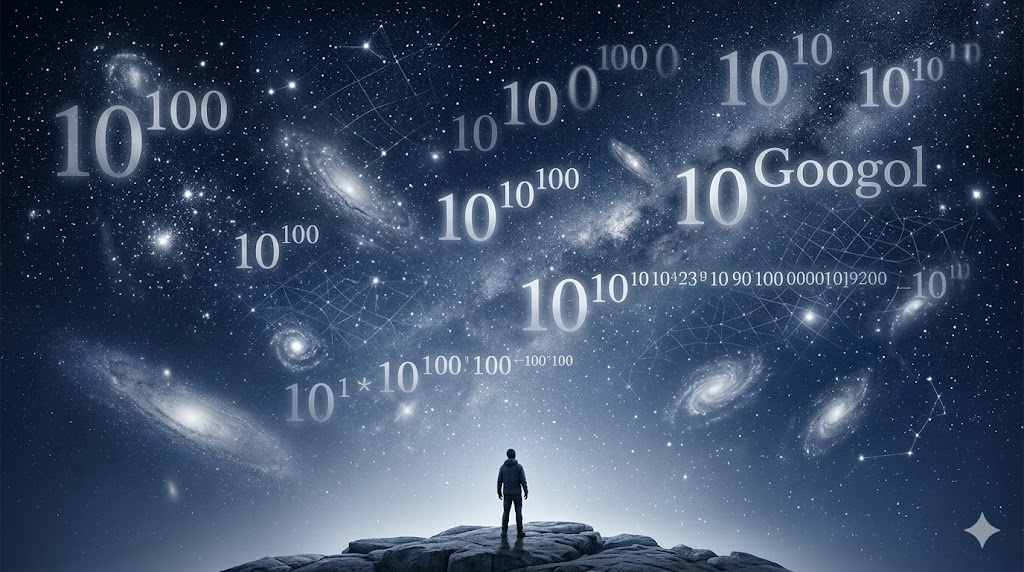
Human beings are surprisingly bad at understanding very large numbers.
A thousand feels big.
A million feels enormous.
A billion already becomes abstract.
And beyond that point, numbers begin to drift away from ordinary human intuition altogether.
Yet mathematics continues.
Far beyond billions.
Far beyond trillions.
Far beyond anything the physical universe itself seems capable of containing.
Counting the World
Large numbers become easier to understand when attached to real things.
There are approximately:
- grains of sand in a small pile
- people on Earth
- stars in a galaxy
- fish in the oceans
- atoms inside the Sun
- atoms in the Milky Way
At these scales, numbers still feel connected to reality.
They describe objects that physically exist.
But eventually, something strange begins to happen.
Reality starts running out of things to count.
The Loneliness of Enormous Numbers
An octovigintillion is:
It is a 1 followed by 87 zeros.
And outside pure mathematics, it has almost nothing to do.
There are not enough stars.
Not enough planets.
Not enough atoms.
Not enough grains of dust in the observable universe to make such a number feel tangible.
The number exists perfectly within mathematics.
But the physical universe can no longer provide examples large enough to give it meaning.
At some point, numbers become larger than reality itself.
When Mathematics Escapes the Physical World
This is one of the strangest moments in mathematics.
For smaller quantities, numbers describe the world around us.
Five apples.
Ten buildings.
One million cells.
But enormous numbers belong to a different realm.
They are no longer tied to physical objects.
They become purely conceptual structures.
The universe stops being large enough to illustrate them.
And yet mathematics continues effortlessly beyond them.
The Human Brain and Scale
Part of the difficulty comes from the way human intuition evolved.
Our ancestors needed to estimate:
- distance
- food
- danger
- time
- groups of people
Nobody evolved to intuitively understand .
To the human brain, the difference between:
and
feels almost meaningless.
Both simply register as “unimaginably huge.”
Mathematics, however, sees a colossal difference.
Infinity Is Different
Surprisingly, infinity is not merely a very large number.
Infinity behaves differently from all finite quantities.
Even numbers so large that the universe cannot physically represent them are still finite.
They still end.
Infinity does not.
And this creates a fascinating psychological effect.
Sometimes infinity feels emotionally easier to imagine than gigantic finite numbers.
A truly enormous finite quantity feels strangely lonely.
Infinity feels boundless.
Numbers Searching for Meaning
Perhaps that is why gigantic numbers possess a certain philosophical beauty.
They reveal something unexpected:
Mathematics is not limited by physical reality.
The universe itself may be finite.
But mathematical possibility appears endless.
Long after matter, stars, and galaxies run out, numbers continue growing silently beyond them.
Waiting.
Almost like ideas searching for a universe large enough to contain them.
Beyond Reality
The deeper one travels into mathematics, the stranger the landscape becomes.
There are quantities so immense that no physical process could ever count them individually.
Numbers so large that writing all their digits would require more atoms than exist in the observable universe.
And yet they remain perfectly valid mathematical objects.
Perhaps this is one of the most extraordinary powers of mathematics.
It allows the human mind to move beyond physical existence itself.
Beyond stars.
Beyond galaxies.
Beyond matter.
Into worlds built entirely from thought.