Every International Mathematical Olympiad has a Problem 6.
The problem contestants whisper about in hotel corridors.
The one saved for last.
The one that sometimes defeats almost everyone.
And in the IMO of 1988, Problem 6 became legendary.
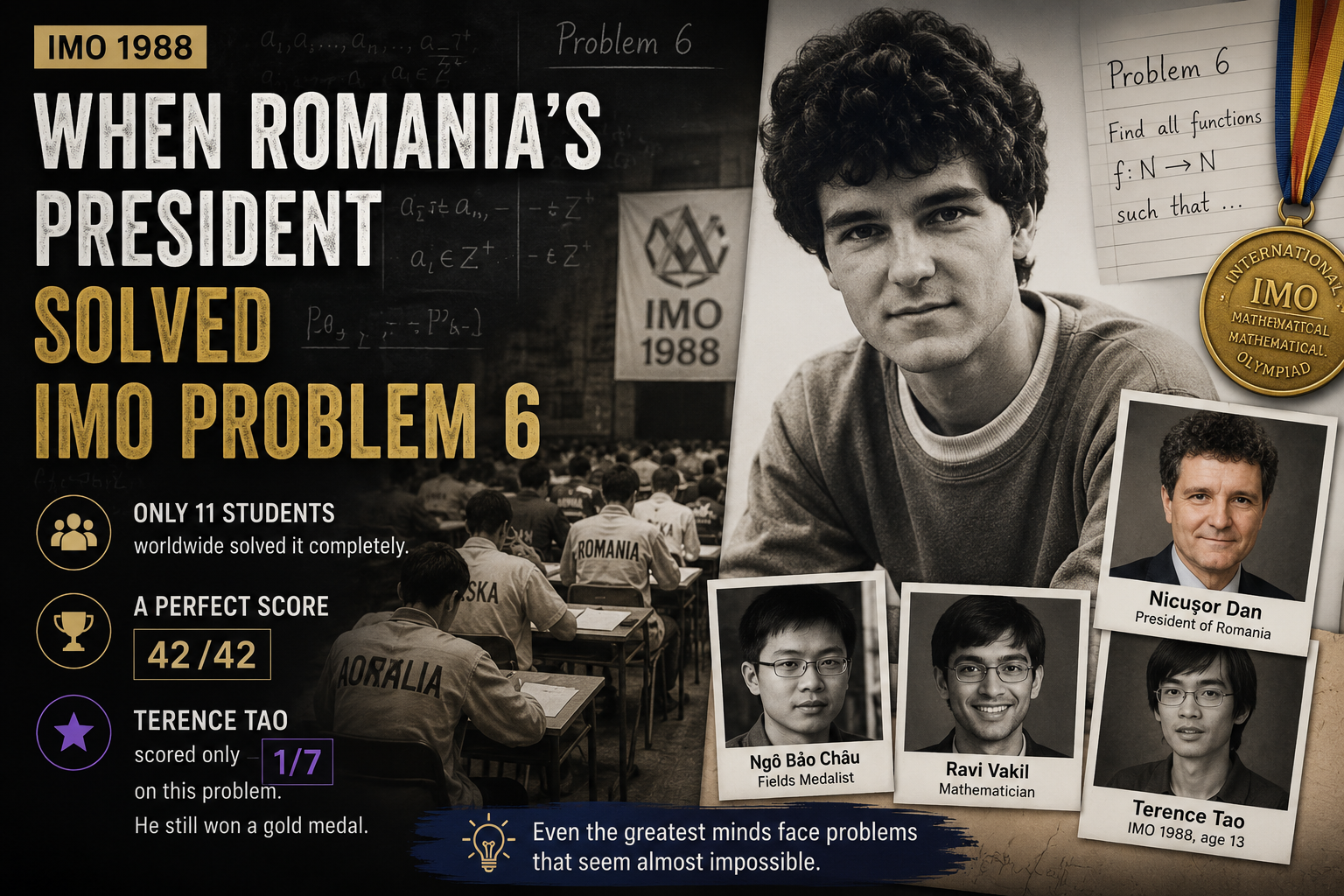
Only 11 Students Solved It
The International Mathematical Olympiad of 1988 gathered some of the most brilliant young mathematical minds in the world.
But when students reached the final problem of the competition, most got stuck.
Only 11 contestants worldwide managed to fully solve the famous Problem 6.
Among them was a Romanian student named Nicușor Dan.
Decades later, he would become the President of Romania.
A Perfect Score
Nicușor Dan did not merely solve the hardest problem.
He achieved a perfect score:
42 / 42
That same year, another contestant also achieved a perfect score:
Ngô Bảo Châu, who would later win the prestigious Fields Medal, often described as the Nobel Prize of mathematics.
Another full solver of Problem 6 was future Stanford mathematician Ravi Vakil.
The participant list of IMO 1988 now reads almost like a future hall of fame.
And Then There Was Terence Tao
Perhaps the most astonishing part of the story involves Terence Tao.
At the time, Tao was only 13 years old.
Already considered a prodigy, he performed extraordinarily well throughout the competition.
But on Problem 6, he scored only:
1 / 7
And yet, despite that result, he still won a gold medal.
Years later, Terence Tao would become one of the greatest mathematicians of modern times.
Which makes the story even more fascinating.
Even extraordinary genius can meet problems that resist solution.
The Actual Problem
The famous Problem 6 of IMO 1988 stated:
At first glance, the statement appears deceptively simple.
But beneath its elegant surface lies a remarkably deep number theory argument involving divisibility, infinite descent, and hidden algebraic structure.
For many contestants, finding the right idea was extraordinarily difficult.
Why Problem 6 Is Different
Within the IMO community, Problem 6 has a mythical reputation.
It is traditionally the final problem of the Olympiad — usually the most creative, the most unexpected, and often the most difficult.
Unlike standard textbook exercises, Problem 6 rarely rewards routine technique alone.
It demands something deeper:
- sudden insight
- originality
- mathematical courage
- and the ability to see patterns nobody else sees
Many contestants describe the experience not as "solving a problem," but as entering a completely different world of thinking.
A Reminder About Mathematics
Stories like this reveal something important about mathematics.
The greatest mathematicians are not people who solve everything instantly.
They are people willing to struggle with extremely difficult ideas.
Sometimes they fail.
Sometimes they get stuck.
And sometimes, years later, the world remembers the single problem that almost nobody could solve.
The Original Problems of IMO 1988
If you would like to explore the authentic problems from the 1988 International Mathematical Olympiad, you can find them here:
"Mathematics is not about never failing.
It is about continuing to think where others stop."
EisatoponAI
Mathematics, ideas, and the stories behind them.